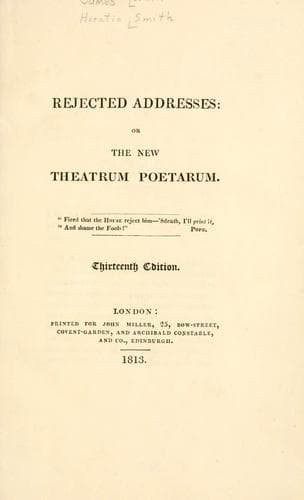
Rejected Addresses; Or, The New Theatrum PoetarumSmith, James
General
Rejected Addresses; Or, The New Theatrum Poetarum
Smith, James
Parodies
It is not necessary for the Editor to mention the manner in which he
became possessed of this “fair sample of the present state of poetry in
Great Britain.” It was his first intention to publish the whole; but a
little reflection convinced him that, by so doing, he might depress the
good, without elevating the bad. He has therefore culled what had the
appearance of flowers, from what possessed the reality of weeds, and is
extremely sorry that, in so doing, he has diminished his collection to
twenty-one. Those which he has rejected may possibly make their
appearance in a separate volume, or they may be admitted as volunteers in
the files of some of the newspapers; or, at all events, they are sure of
being received among the awkward squad of the Magazines. In general,
they bear a close resemblance to each other; thirty of them contain
extravagant compliments to the immortal Wellington and the indefatigable
Whitbread; and, as the last-mentioned gentleman is said to dislike praise
in the exact proportion in which he deserves it, these laudatory writers
have probably been only building a wall against which they might run
their own heads.
The Editor here begs leave to advance a few words in behalf of that
useful and much abused bird the Phoenix; and in so doing he is biassed by
no partiality, as he assures the reader he not only never saw one, but
(_mirabile dictu_!) never caged one, in a simile, in the whole course of
his life. Not less than sixty-nine of the competitors have invoked the
aid of this native of Arabia; but as, from their manner of using him
after they had caught him, he does not by any means appear to have been a
native of Arabia _Felix_, the Editor has left the proprietors to treat
with Mr. Polito, and refused to receive this _rara avis_, or black swan,
into the present collection. One exception occurs, in which the
admirable treatment of this feathered incombustible entitles the author
to great praise: that Address has been preserved, and in the ensuing
pages takes the lead, to which its dignity entitles it.
Public-domain text, read in full here on John Shaqi.
Reviews
Reviews
No reviews yet
Be the first to share your thoughts on this work.
Join the Discussion
Join the discussion
Sign in to leave a comment or review.
Sign InorCreate an account