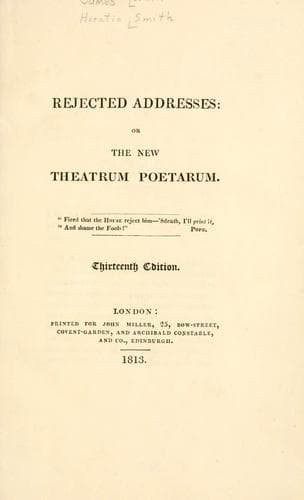
Rejected Addresses; Or, The New Theatrum Poetarum — John Shaqi
Rejected Addresses; Or, The New Theatrum PoetarumSmith, James
General
Rejected Addresses; Or, The New Theatrum Poetarum
Smith, James
Parodies
Perhaps the reason why several of the subjoined productions of the MUSÆ
LONDINENSES have failed of selection, may be discovered in their being
penned in a metre unusual upon occasions of this sort, and in their not
being written with that attention to stage effect, the want of which,
like want of manners in the concerns of life, is more prejudicial than a
deficiency of talent. There is an art of writing for the Theatre,
technically called _touch_ and _go_, which is indispensable when we
consider the small quantum of patience which so motley an assemblage as a
London audience can be expected to afford. All the contributors have
been very exact in sending their initials and mottoes. Those belonging
to the present collection have been carefully preserved, and each has
been affixed to its respective poem. The letters that accompanied the
Addresses having been honourably destroyed unopened, it is impossible to
state the real authors with any certainty; but the ingenious reader,
after comparing the initials with the motto, and both with the poem, may
form his own conclusions.
The Editor does not anticipate any disapprobation from thus giving
publicity to a small portion of the _Rejected Addresses_; for unless he
is widely mistaken in assigning the respective authors, the fame of each
individual is established on much too firm a basis to be shaken by so
trifling and evanescent a publication as the present:
— neque ego illi detrahere ausim
Hærentem capiti multâ cum laude coronam.
Of the numerous pieces already sent to the Committee for performance, he
has only availed himself of three vocal Travesties, which he has
selected, not for their merit, but simply for their brevity. Above one
hundred spectacles, melodramas, operas, and pantomimes have been
transmitted, besides the two first acts of one legitimate comedy. Some
of these evince considerable smartness of manual dialogue, and several
brilliant repartees of chairs, tables, and other inanimate wits; but the
authors seem to have forgotten that in the new Drury Lane the audience
can hear as well as see. Of late our theatres have been so constructed,
that John Bull has been compelled to have very long ears, or none at all;
to keep them dangling about his skull like discarded servants, while his
eyes were gazing at pieballs and elephants, or else to stretch them out
to an asinine length to catch the congenial sound of braying trumpets.
An auricular revolution is, we trust, about to take place; and as many
people have been much puzzled to define the meaning of the new era, of
which we have heard so much, we venture to pronounce that, as far as
regards Drury Lane Theatre, the new era means the reign of ears. If the
past affords any pledge for the future, we may confidently expect from
the Committee of that House every thing that can be accomplished by the
union of taste and assiduity.
Public-domain text, read in full here on John Shaqi.
Reviews
Reviews
No reviews yet
Be the first to share your thoughts on this work.
Join the Discussion
Join the discussion
Sign in to leave a comment or review.
Sign InorCreate an account