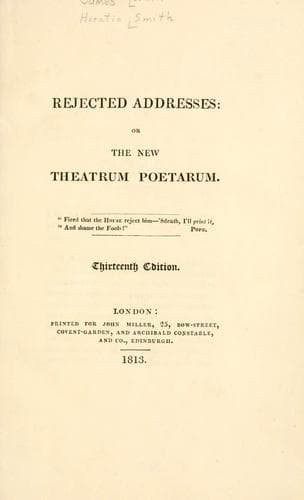
Rejected Addresses; Or, The New Theatrum PoetarumSmith, James
General
Rejected Addresses; Or, The New Theatrum Poetarum
Smith, James
Parodies
{8} This alludes to the Young Betty mania. The writer was in the
stage-box at the height of this young gentleman’s popularity. One of the
other occupants offered, in a loud voice, to prove that Young Betty did
not understand Shakespeare. “Silence!” was the cry; but he still
proceeded. “Turn him out!” was the next ejaculation. He still
vociferated. “He does not understand Shakespeare;” and was consequently
shouldered into the lobby. “I’ll prove it to you,” said the critic to
the doorkeeper. “Prove what, sir?” “That he does not understand
Shakespeare.” This was Molière’s housemaid with a vengeance.
Young Betty may now [1833] be seen walking about town—a portly personage,
aged about forty—clad in a furred and frogged surtout; probably muttering
to himself (as he has been at college), “O mihi præteritos!” &c. [He is
still alive, 1854. Master Betty, or the “Young Roscius,” was born in
1791, and made his first appearance on a London stage as Achmet in
“Barbarossa,” at Covent Garden Theatre, on the lst of December, 1804. He
was, therefore, “not quite thirteen.” He lasted two seasons.]
{10a} A “Phoenix” was perhaps excusable. The first theatre in Drury
Lane was called “The Cock-pit or Phoenix Theatre.” Whitbread himself
wrote an address, it is said, for the occasion; like the others, it had
of course a Phoenix. “But Whitbread,” said Sheridan, “made more of the
bird than any of them; he entered into particulars, and described its
wings, beak, tail, &c.; in short, it was a _poulterer’s_ description of a
Phoenix.”
{10b} For an account of this anonymous gentleman, see Preface, xiii.
{12a} “The author has succeeded better in copying the melody and
misanthropic sentiments of _Childe Harold_, than the nervous and
impetuous diction in which his noble biographer has embodied them. The
attempt, however, indicates very considerable power; and the flow of the
verse and the construction of the poetical period are imitated with no
ordinary skill.”—JEFFREY, _Edinburgh Review_.
Public-domain text, read in full here on John Shaqi.
Reviews
Reviews
No reviews yet
Be the first to share your thoughts on this work.
Elsewhere in the archive
Join the Discussion
Join the discussion
Sign in to leave a comment or review.
Sign InorCreate an account