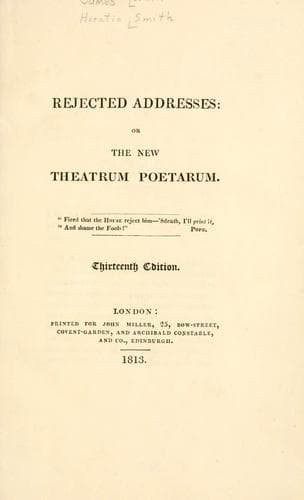
Rejected Addresses; Or, The New Theatrum PoetarumSmith, James
General
Rejected Addresses; Or, The New Theatrum Poetarum
Smith, James
Parodies
{12b} This would seem to show that poet and prophet are synonymous, the
noble bard having afterwards returned to England, and again quitted it,
under domestic circumstances painfully notorious. His good-humoured
forgiveness of the Authors has already been alluded to in the Preface.
Nothing of this illustrious poet, however trivial, can be otherwise than
interesting. “We know him well.” At Mr. Murray’s dinner-table the
annotator met him and Sir John Malcolm. Lord Byron talked of intending
to travel in Persia. “What must I do when I set off?” said he to Sir
John. “Cut off your buttons!” “My buttons! what, these metal ones!”
“Yes; the Persians are in the main very honest fellows; but if you go
thus bedizened, you will infallibly be murdered for your buttons!” At a
dinner at Monk Lewis’s chambers in the Albany, Lord Byron expressed to
the writer his determination not to go there again, adding, “I never will
dine with a middle-aged man who fills up his table with young ensigns,
and has looking-glass panels to his book-cases.” Lord Byron, when one of
the Drury-lane Committee of Management, challenged the writer to sing
alternately (like the swains in Virgil) the praises of Mrs. Mardyn, the
actress, who, by-the-bye, was hissed off the stage for an imputed
intimacy of which she was quite innocent.
The contest ran as fellows:
“Wake, muse of fire, your ardent lyre,
Pour forth your amorous ditty,
But first profound, in duly bound,
Applaud the new Committee;
Their scenic art from Thespis’ cart
All jaded nags discarding,
To London drove this queen of love,
Enchanting Mrs. Mardyn.
Though tides of love around her rove,
I fear she’ll choose Pactolus—
In that bright surge bards ne’er immerge.
So I must e’en swim solus.
‘Out, out, alas!’ ill-fated gas,
That shin’st round Covent Garden,
Thy ray how flat, compared with that
From eye of Mrs. Mardyn!”
And so on. The reader has, no doubt, already discovered “which is the
justice, and which is the thief.”
Lord Byron at that time wore a very narrow cravat of white sarsnet, with
the shirt-collar falling over it; a black coat and waist-coat, and very
broad white trousers to hide his lame foot—these were of Russia duck in
the morning, and jean in the evening. His watch-chain had a number of
small gold seals appended to it, and was looped up to a button of his
waistcoat. His face was void of colour; he wore no whiskers. His eyes
were grey, fringed with long black lashes; and his air was imposing, but
rather supercilious. He under-valued David Hume; denying his claim to
genius on account of his bulk, and calling him, from the Heroic Epistle,
“The fattest hog in Epicurus’ sly.”
Public-domain text, read in full here on John Shaqi.
Reviews
Reviews
No reviews yet
Be the first to share your thoughts on this work.
Elsewhere in the archive
Join the Discussion
Join the discussion
Sign in to leave a comment or review.
Sign InorCreate an account