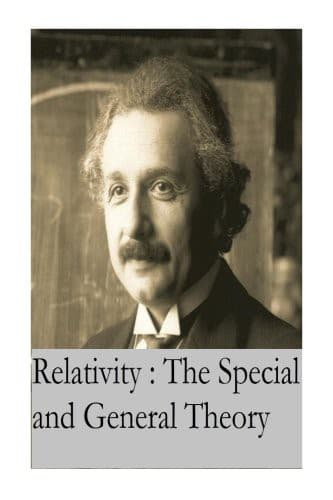
Relativity: The Special and General TheoryEinstein, Albert
Science
Relativity: The Special and General Theory
Einstein, Albert
Relativity (Physics)
We now proceed to the second argument, to which, moreover, we shall
return later. If the principle of relativity (in the restricted sense)
does not hold, then the Galileian co-ordinate systems _K, K′, K″_,
etc., which are moving uniformly relative to each other, will not be
_equivalent_ for the description of natural phenomena. In this case we
should be constrained to believe that natural laws are capable of being
formulated in a particularly simple manner, and of course only on
condition that, from amongst all possible Galileian co-ordinate
systems, we should have chosen _one_ (_K0_) of a particular state of
motion as our body of reference. We should then be justified (because
of its merits for the description of natural phenomena) in calling this
system “absolutely at rest,” and all other Galileian systems _K_ “in
motion.” If, for instance, our embankment were the system _K0_ then our
railway carriage would be a system _K_, relative to which less simple
laws would hold than with respect to _K0_. This diminished simplicity
would be due to the fact that the carriage _K_ would be in motion
(_i.e._ “really”)with respect to _K0_. In the general laws of nature
which have been formulated with reference to _K_, the magnitude and
direction of the velocity of the carriage would necessarily play a
part. We should expect, for instance, that the note emitted by an
organpipe placed with its axis parallel to the direction of travel
would be different from that emitted if the axis of the pipe were
placed perpendicular to this direction.
Now in virtue of its motion in an orbit round the sun, our earth is
comparable with a railway carriage travelling with a velocity of about
30 kilometres per second. If the principle of relativity were not valid
we should therefore expect that the direction of motion of the earth at
any moment would enter into the laws of nature, and also that physical
systems in their behaviour would be dependent on the orientation in
space with respect to the earth. For owing to the alteration in
direction of the velocity of revolution of the earth in the course of a
year, the earth cannot be at rest relative to the hypothetical system
_K0_ throughout the whole year. However, the most careful observations
have never revealed such anisotropic properties in terrestrial physical
space, _i.e._ a physical non-equivalence of different directions. This
is very powerful argument in favour of the principle of relativity.
VI.
THE THEOREM OF THE ADDITION OF VELOCITIES EMPLOYED IN CLASSICAL
MECHANICS
Public-domain text, read in full here on John Shaqi.
Reviews
Reviews
No reviews yet
Be the first to share your thoughts on this work.
Join the Discussion
Join the discussion
Sign in to leave a comment or review.
Sign InorCreate an account