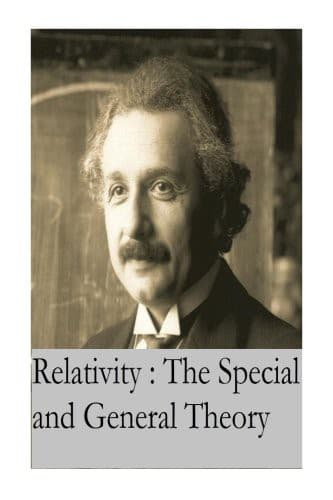
Relativity: The Special and General TheoryEinstein, Albert
Science
Relativity: The Special and General Theory
Einstein, Albert
Relativity (Physics)
Let us suppose our old friend the railway carriage to be travelling
along the rails with a constant velocity _v_, and that a man traverses
the length of the carriage in the direction of travel with a velocity
_w_. How quickly or, in other words, with what velocity _W_ does the
man advance relative to the embankment during the process? The only
possible answer seems to result from the following consideration: If
the man were to stand still for a second, he would advance relative to
the embankment through a distance _v_ equal numerically to the velocity
of the carriage. As a consequence of his walking, however, he traverses
an additional distance w relative to the carriage, and hence also
relative to the embankment, in this second, the distance w being
numerically equal to the velocity with which he is walking. Thus in
total he covers the distance _W = v + w_ relative to the embankment in
the second considered. We shall see later that this result, which
expresses the theorem of the addition of velocities employed in
classical mechanics, cannot be maintained; in other words, the law that
we have just written down does not hold in reality. For the time being,
however, we shall assume its correctness.
VII.
THE APPARENT INCOMPATIBILITY OF THE LAW OF PROPAGATION OF LIGHT WITH
THE PRINCIPLE OF RELATIVITY
There is hardly a simpler law in physics than that according to which
light is propagated in empty space. Every child at school knows, or
believes he knows, that this propagation takes place in straight lines
with a velocity _c_ = 300,000 km./sec. At all events we know with great
exactness that this velocity is the same for all colours, because if
this were not the case, the minimum of emission would not be observed
simultaneously for different colours during the eclipse of a fixed star
by its dark neighbour. By means of similar considerations based on
observations of double stars, the Dutch astronomer De Sitter was also
able to show that the velocity of propagation of light cannot depend on
the velocity of motion of the body emitting the light. The assumption
that this velocity of propagation is dependent on the direction “in
space” is in itself improbable.
In short, let us assume that the simple law of the constancy of the
velocity of light _c_ (in vacuum) is justifiably believed by the child
at school. Who would imagine that this simple law has plunged the
conscientiously thoughtful physicist into the greatest intellectual
difficulties? Let us consider how these difficulties arise.
Public-domain text, read in full here on John Shaqi.
Reviews
Reviews
No reviews yet
Be the first to share your thoughts on this work.
Join the Discussion
Join the discussion
Sign in to leave a comment or review.
Sign InorCreate an account