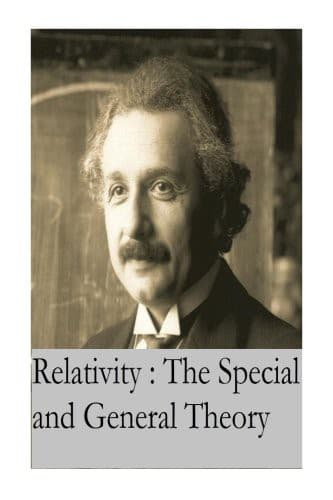
Relativity: The Special and General TheoryEinstein, Albert
Science
Relativity: The Special and General Theory
Einstein, Albert
Relativity (Physics)
In view of this dilemma there appears to be nothing else for it than to
abandon either the principle of relativity or the simple law of the
propagation of light _in vacuo_. Those of you who have carefully
followed the preceding discussion are almost sure to expect that we
should retain the principle of relativity, which appeals so
convincingly to the intellect because it is so natural and simple. The
law of the propagation of light _in vacuo_ would then have to be
replaced by a more complicated law conformable to the principle of
relativity. The development of theoretical physics shows, however, that
we cannot pursue this course. The epoch-making theoretical
investigations of H. A. Lorentz on the electrodynamical and optical
phenomena connected with moving bodies show that experience in this
domain leads conclusively to a theory of electromagnetic phenomena, of
which the law of the constancy of the velocity of light in vacuo is a
necessary consequence. Prominent theoretical physicists were therefore
more inclined to reject the principle of relativity, in spite of the
fact that no empirical data had been found which were contradictory to
this principle.
At this juncture the theory of relativity entered the arena. As a
result of an analysis of the physical conceptions of time and space, it
became evident that _in reality there is not the least incompatibilitiy
between the principle of relativity and the law of propagation of
light_, and that by systematically holding fast to both these laws a
logically rigid theory could be arrived at. This theory has been called
the _special theory of relativity_ to distinguish it from the extended
theory, with which we shall deal later. In the following pages we shall
present the fundamental ideas of the special theory of relativity.
VIII.
ON THE IDEA OF TIME IN PHYSICS
Lightning has struck the rails on our railway embankment at two places
_A_ and _B_ far distant from each other. I make the additional
assertion that these two lightning flashes occurred simultaneously. If
I ask you whether there is sense in this statement, you will answer my
question with a decided “Yes.” But if I now approach you with the
request to explain to me the sense of the statement more precisely, you
find after some consideration that the answer to this question is not
so easy as it appears at first sight.
Public-domain text, read in full here on John Shaqi.
Reviews
Reviews
No reviews yet
Be the first to share your thoughts on this work.
Join the Discussion
Join the discussion
Sign in to leave a comment or review.
Sign InorCreate an account