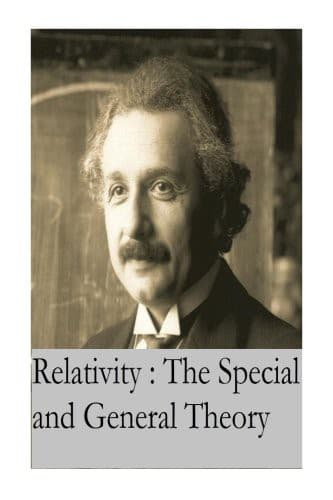
Relativity: The Special and General TheoryEinstein, Albert
Science
Relativity: The Special and General Theory
Einstein, Albert
Relativity (Physics)
After some time perhaps the following answer would occur to you: “The
significance of the statement is clear in itself and needs no further
explanation; of course it would require some consideration if I were to
be commissioned to determine by observations whether in the actual case
the two events took place simultaneously or not.” I cannot be satisfied
with this answer for the following reason. Supposing that as a result
of ingenious considerations an able meteorologist were to discover that
the lightning must always strike the places _A_ and _B_ simultaneously,
then we should be faced with the task of testing whether or not this
theoretical result is in accordance with the reality. We encounter the
same difficulty with all physical statements in which the conception
“simultaneous” plays a part. The concept does not exist for the
physicist until he has the possibility of discovering whether or not it
is fulfilled in an actual case. We thus require a definition of
simultaneity such that this definition supplies us with the method by
means of which, in the present case, he can decide by experiment
whether or not both the lightning strokes occurred simultaneously. As
long as this requirement is not satisfied, I allow myself to be
deceived as a physicist (and of course the same applies if I am not a
physicist), when I imagine that I am able to attach a meaning to the
statement of simultaneity. (I would ask the reader not to proceed
farther until he is fully convinced on this point.)
After thinking the matter over for some time you then offer the
following suggestion with which to test simultaneity. By measuring
along the rails, the connecting line _AB_ should be measured up and an
observer placed at the mid-point M of the distance _AB_. This observer
should be supplied with an arrangement (_e.g._ two mirrors inclined at
90°) which allows him visually to observe both places _A_ and _B_ at
the same time. If the observer perceives the two flashes of lightning
at the same time, then they are simultaneous.
I am very pleased with this suggestion, but for all that I cannot
regard the matter as quite settled, because I feel constrained to raise
the following objection: “Your definition would certainly be right, if
only I knew that the light by means of which the observer at _M_
perceives the lightning flashes travels along the length _A_ → _M_ with
the same velocity as along the length _B_ → _M_. But an examination of
this supposition would only be possible if we already had at our
disposal the means of measuring time. It would thus appear as though we
were moving here in a logical circle.”
Public-domain text, read in full here on John Shaqi.
Reviews
Reviews
No reviews yet
Be the first to share your thoughts on this work.
Join the Discussion
Join the discussion
Sign in to leave a comment or review.
Sign InorCreate an account