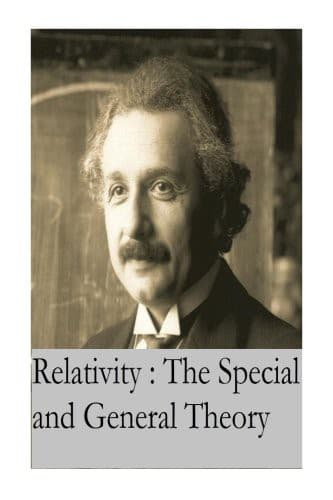
Relativity: The Special and General Theory — John Shaqi
Relativity: The Special and General TheoryEinstein, Albert
Science
Relativity: The Special and General Theory
Einstein, Albert
Relativity (Physics)
After further consideration you cast a somewhat disdainful glance at
me—and rightly so—and you declare: “I maintain my previous definition
nevertheless, because in reality it assumes absolutely nothing about
light. There is only _one_ demand to be made of the definition of
simultaneity, namely, that in every real case it must supply us with an
empirical decision as to whether or not the conception that has to be
defined is fulfilled. That my definition satisfies this demand is
indisputable. That light requires the same time to traverse the path
_A_ → _M_ as for the path _B_ → _M_ is in reality neither a
_supposition nor a hypothesis_ about the physical nature of light, but
a _stipulation_ which I can make of my own freewill in order to arrive
at a definition of simultaneity.”
It is clear that this definition can be used to give an exact meaning
not only to _two_ events, but to as many events as we care to choose,
and independently of the positions of the scenes of the events with
respect to the body of reference[7] (here the railway embankment). We
are thus led also to a definition of “time” in physics. For this
purpose we suppose that clocks of identical construction are placed at
the points _A, B_ and _C_ of the railway line (co-ordinate system) and
that they are set in such a manner that the positions of their pointers
are simultaneously (in the above sense) the same. Under these
conditions we understand by the “time” of an event the reading
(position of the hands) of that one of these clocks which is in the
immediate vicinity (in space) of the event. In this manner a time-value
is associated with every event which is essentially capable of
observation.
[7] We suppose further that, when three events _A, B_ and _C_ occur in
different places in such a manner that, if _A_ is simultaneous with
_B_, and _B_ is simultaneous with _C_ (simultaneous in the sense of
the above definition), then the criterion for the simultaneity of the
pair of events _A, C_ is also satisfied. This assumption is a physical
hypothesis about the law of propagation of light; it must certainly be
fulfilled if we are to maintain the law of the constancy of the
velocity of light _in vacuo_.
This stipulation contains a further physical hypothesis, the validity
of which will hardly be doubted without empirical evidence to the
contrary. It has been assumed that all these clocks _go at the same
rate_ if they are of identical construction. Stated more exactly: When
two clocks arranged at rest in different places of a reference-body are
set in such a manner that a _particular_ position of the pointers of
the one clock is _simultaneous_ (in the above sense) with the _same_
position, of the pointers of the other clock, then identical “settings”
are always simultaneous (in the sense of the above definition).
IX.
THE RELATIVITY OF SIMULTANEITY
Public-domain text, read in full here on John Shaqi.
Reviews
Reviews
No reviews yet
Be the first to share your thoughts on this work.
Join the Discussion
Join the discussion
Sign in to leave a comment or review.
Sign InorCreate an account