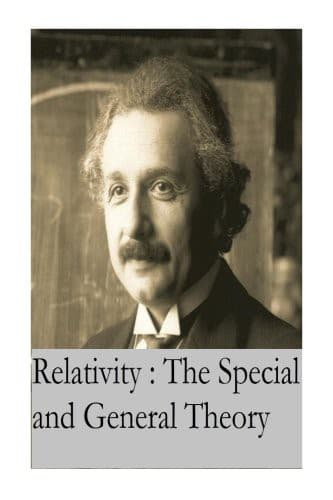
Relativity: The Special and General TheoryEinstein, Albert
Science
Relativity: The Special and General Theory
Einstein, Albert
Relativity (Physics)
It is clear that we have the problem of Section VI again before us. The
tube plays the part of the railway embankment or of the co-ordinate
system _K_, the liquid plays the part of the carriage or of the
co-ordinate system _K′_, and finally, the light plays the part of the
man walking along the carriage, or of the moving point in the present
section. If we denote the velocity of the light relative to the tube by
_W_, then this is given by the equation (A) or (B), according as the
Galilei transformation or the Lorentz transformation corresponds to the
facts. Experiment[10] decides in favour of equation (B) derived from
the theory of relativity, and the agreement is, indeed, very exact.
According to recent and most excellent measurements by Zeeman, the
influence of the velocity of flow _v_ on the propagation of light is
represented by formula (B) to within one per cent.
[10] Fizeau found
image015
where
image016
is the index of refraction of the liquid. On the other hand, owing to
the smallness of
image017
as compared with 1, we can replace (B) in the first place by
image018
or to the same order of approximation by
image019
which agrees with Fizeau’s result.
Nevertheless we must now draw attention to the fact that a theory of
this phenomenon was given by H. A. Lorentz long before the statement of
the theory of relativity. This theory was of a purely electrodynamical
nature, and was obtained by the use of particular hypotheses as to the
electromagnetic structure of matter. This circumstance, however, does
not in the least diminish the conclusiveness of the experiment as a
crucial test in favour of the theory of relativity, for the
electrodynamics of Maxwell-Lorentz, on which the original theory was
based, in no way opposes the theory of relativity. Rather has the
latter been developed trom electrodynamics as an astoundingly simple
combination and generalisation of the hypotheses, formerly independent
of each other, on which electrodynamics was built.
XIV.
THE HEURISTIC VALUE OF THE THEORY OF RELATIVITY
Our train of thought in the foregoing pages can be epitomised in the
following manner. Experience has led to the conviction that, on the one
hand, the principle of relativity holds true and that on the other hand
the velocity of transmission of light _in vacuo_ has to be considered
equal to a constant _c_. By uniting these two postulates we obtained
the law of transformation for the rectangular co-ordinates _x, y, z_
and the time _t_ of the events which constitute the processes of
nature. In this connection we did not obtain the Galilei
transformation, but, differing from classical mechanics, the _Lorentz
transformation_.
The law of transmission of light, the acceptance of which is justified
by our actual knowledge, played an important part in this process of
thought. Once in possession of the Lorentz transformation, however, we
can combine this with the principle of relativity, and sum up the
theory thus:
Public-domain text, read in full here on John Shaqi.
Reviews
Reviews
No reviews yet
Be the first to share your thoughts on this work.
Join the Discussion
Join the discussion
Sign in to leave a comment or review.
Sign InorCreate an account