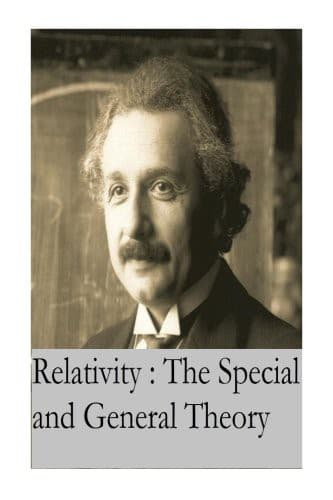
Relativity: The Special and General TheoryEinstein, Albert
Science
Relativity: The Special and General Theory
Einstein, Albert
Relativity (Physics)
Every general law of nature must be so constituted that it is
transformed into a law of exactly the same form when, instead of the
space-time variables _x, y, z, t_ of the original coordinate system
_K_, we introduce new space-time variables _x′, y′, z′, t′_ of a
co-ordinate system _K′_. In this connection the relation between the
ordinary and the accented magnitudes is given by the Lorentz
transformation. Or in brief: General laws of nature are co-variant with
respect to Lorentz transformations.
This is a definite mathematical condition that the theory of relativity
demands of a natural law, and in virtue of this, the theory becomes a
valuable heuristic aid in the search for general laws of nature. If a
general law of nature were to be found which did not satisfy this
condition, then at least one of the two fundamental assumptions of the
theory would have been disproved. Let us now examine what general
results the latter theory has hitherto evinced.
XV.
GENERAL RESULTS OF THE THEORY
It is clear from our previous considerations that the (special) theory
of relativity has grown out of electrodynamics and optics. In these
fields it has not appreciably altered the predictions of theory, but it
has considerably simplified the theoretical structure, _i.e._ the
derivation of laws, and—what is incomparably more important—it has
considerably reduced the number of independent hypotheses forming the
basis of theory. The special theory of relativity has rendered the
Maxwell-Lorentz theory so plausible, that the latter would have been
generally accepted by physicists even if experiment had decided less
unequivocally in its favour.
Classical mechanics required to be modified before it could come into
line with the demands of the special theory of relativity. For the main
part, however, this modification affects only the laws for rapid
motions, in which the velocities of matter _v_ are not very small as
compared with the velocity of light. We have experience of such rapid
motions only in the case of electrons and ions; for other motions the
variations from the laws of classical mechanics are too small to make
themselves evident in practice. We shall not consider the motion of
stars until we come to speak of the general theory of relativity. In
accordance with the theory of relativity the kinetic energy of a
material point of mass _m_ is no longer given by the well-known
expression
image020
but by the expression
image021
This expression approaches infinity as the velocity _v_ approaches the
velocity of light _c_. The velocity must therefore always remain less
than _c_, however great may be the energies used to produce the
acceleration. If we develop the expression for the kinetic energy in
the form of a series, we obtain
image022
When
image023
Public-domain text, read in full here on John Shaqi.
Reviews
Reviews
No reviews yet
Be the first to share your thoughts on this work.
Join the Discussion
Join the discussion
Sign in to leave a comment or review.
Sign InorCreate an account