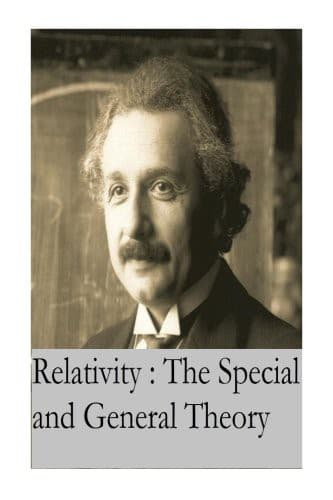
Relativity: The Special and General TheoryEinstein, Albert
Science
Relativity: The Special and General Theory
Einstein, Albert
Relativity (Physics)
is small compared with unity, the third of these terms is always small
in comparison with the second, which last is alone considered in
classical mechanics. The first term _mc_2 does not contain the
velocity, and requires no consideration if we are only dealing with the
question as to how the energy of a point-mass; depends on the velocity.
We shall speak of its essential significance later.
The most important result of a general character to which the special
theory of relativity has led is concerned with the conception of mass.
Before the advent of relativity, physics recognised two conservation
laws of fundamental importance, namely, the law of the conservation of
energy and the law of the conservation of mass these two fundamental
laws appeared to be quite independent of each other. By means of the
theory of relativity they have been united into one law. We shall now
briefly consider how this unification came about, and what meaning is
to be attached to it.
The principle of relativity requires that the law of the conservation
of energy should hold not only with reference to a co-ordinate system
_K_, but also with respect to every co-ordinate system _K′_ which is in
a state of uniform motion of translation relative to _K_, or, briefly,
relative to every “Galileian” system of co-ordinates. In contrast to
classical mechanics; the Lorentz transformation is the deciding factor
in the transition from one such system to another.
By means of comparatively simple considerations we are led to draw the
following conclusion from these premises, in conjunction with the
fundamental equations of the electrodynamics of Maxwell: A body moving
with the velocity _v_, which absorbs[11] an amount of energy _E_0 in
the form of radiation without suffering an alteration in velocity in
the process, has, as a consequence, its energy increased by an amount
image024
[11] _E_0 is the energy taken up, as judged from a co-ordinate system
moving with the body.
In consideration of the expression given above for the kinetic energy
of the body, the required energy of the body comes out to be
image025
Thus the body has the same energy as a body of mass
image026
moving with the velocity _v_. Hence we can say: If a body takes up an
amount of energy _E_0, then its inertial mass increases by an amount
image027
the inertial mass of a body is not a constant but varies according to
the change in the energy of the body. The inertial mass of a system of
bodies can even be regarded as a measure of its energy. The law of the
conservation of the mass of a system becomes identical with the law of
the conservation of energy, and is only valid provided that the system
neither takes up nor sends out energy. Writing the expression for the
energy in the form
image028
we see that the term _mc_2, which has hitherto attracted our attention,
is nothing else than the energy possessed by the body[12] before it
absorbed the energy _E_0.
Public-domain text, read in full here on John Shaqi.
Reviews
Reviews
No reviews yet
Be the first to share your thoughts on this work.
Join the Discussion
Join the discussion
Sign in to leave a comment or review.
Sign InorCreate an account