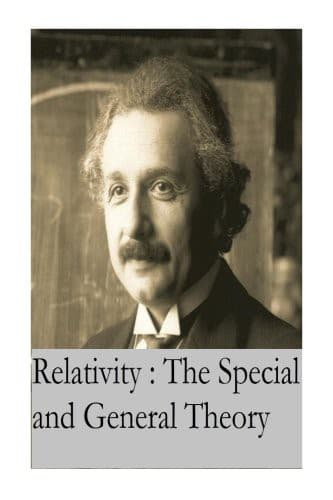
Relativity: The Special and General Theory — John Shaqi
Relativity: The Special and General TheoryEinstein, Albert
Science
Relativity: The Special and General Theory
Einstein, Albert
Relativity (Physics)
Geometry sets out from certain conceptions such as “plane,” “point,”
and “straight line,” with which we are able to associate more or less
definite ideas, and from certain simple propositions (axioms) which, in
virtue of these ideas, we are inclined to accept as “true.” Then, on
the basis of a logical process, the justification of which we feel
ourselves compelled to admit, all remaining propositions are shown to
follow from those axioms, _i.e._ they are proven. A proposition is then
correct (“true”) when it has been derived in the recognised manner from
the axioms. The question of “truth” of the individual geometrical
propositions is thus reduced to one of the “truth” of the axioms. Now
it has long been known that the last question is not only unanswerable
by the methods of geometry, but that it is in itself entirely without
meaning. We cannot ask whether it is true that only one straight line
goes through two points. We can only say that Euclidean geometry deals
with things called “straight lines,” to each of which is ascribed the
property of being uniquely determined by two points situated on it. The
concept “true” does not tally with the assertions of pure geometry,
because by the word “true” we are eventually in the habit of
designating always the correspondence with a “real” object; geometry,
however, is not concerned with the relation of the ideas involved in it
to objects of experience, but only with the logical connection of these
ideas among themselves.
It is not difficult to understand why, in spite of this, we feel
constrained to call the propositions of geometry “true.” Geometrical
ideas correspond to more or less exact objects in nature, and these
last are undoubtedly the exclusive cause of the genesis of those ideas.
Geometry ought to refrain from such a course, in order to give to its
structure the largest possible logical unity. The practice, for
example, of seeing in a “distance” two marked positions on a
practically rigid body is something which is lodged deeply in our habit
of thought. We are accustomed further to regard three points as being
situated on a straight line, if their apparent positions can be made to
coincide for observation with one eye, under suitable choice of our
place of observation.
Public-domain text, read in full here on John Shaqi.
Reviews
Reviews
No reviews yet
Be the first to share your thoughts on this work.
Join the Discussion
Join the discussion
Sign in to leave a comment or review.
Sign InorCreate an account