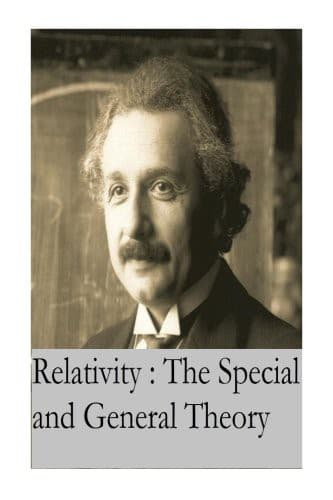
Relativity: The Special and General Theory — John Shaqi
Relativity: The Special and General TheoryEinstein, Albert
Science
Relativity: The Special and General Theory
Einstein, Albert
Relativity (Physics)
If, in pursuance of our habit of thought, we now supplement the
propositions of Euclidean geometry by the single proposition that two
points on a practically rigid body always correspond to the same
distance (line-interval), independently of any changes in position to
which we may subject the body, the propositions of Euclidean geometry
then resolve themselves into propositions on the possible relative
position of practically rigid bodies.[1] Geometry which has been
supplemented in this way is then to be treated as a branch of physics.
We can now legitimately ask as to the “truth” of geometrical
propositions interpreted in this way, since we are justified in asking
whether these propositions are satisfied for those real things we have
associated with the geometrical ideas. In less exact terms we can
express this by saying that by the “truth” of a geometrical proposition
in this sense we understand its validity for a construction with rule
and compasses.
[1] It follows that a natural object is associated also with a
straight line. Three points _A, B_ and _C_ on a rigid body thus lie in
a straight line when the points _A_ and _C_ being given, _B_ is chosen
such that the sum of the distances _AB_ and _BC_ is as short as
possible. This incomplete suggestion will suffice for the present
purpose.
Of course the conviction of the “truth” of geometrical propositions in
this sense is founded exclusively on rather incomplete experience. For
the present we shall assume the “truth” of the geometrical
propositions, then at a later stage (in the general theory of
relativity) we shall see that this “truth” is limited, and we shall
consider the extent of its limitation.
II.
THE SYSTEM OF CO-ORDINATES
On the basis of the physical interpretation of distance which has been
indicated, we are also in a position to establish the distance between
two points on a rigid body by means of measurements. For this purpose
we require a “distance” (rod _S_) which is to be used once and for all,
and which we employ as a standard measure. If, now, _A_ and _B_ are two
points on a rigid body, we can construct the line joining them
according to the rules of geometry; then, starting from _A_, we can
mark off the distance _S_ time after time until we reach _B_. The
number of these operations required is the numerical measure of the
distance _AB_. This is the basis of all measurement of length.[2]
[2] Here we have assumed that there is nothing left over _i.e._ that
the measurement gives a whole number. This difficulty is got over by
the use of divided measuring-rods, the introduction of which does not
demand any fundamentally new method.
Public-domain text, read in full here on John Shaqi.
Reviews
Reviews
No reviews yet
Be the first to share your thoughts on this work.
Join the Discussion
Join the discussion
Sign in to leave a comment or review.
Sign InorCreate an account