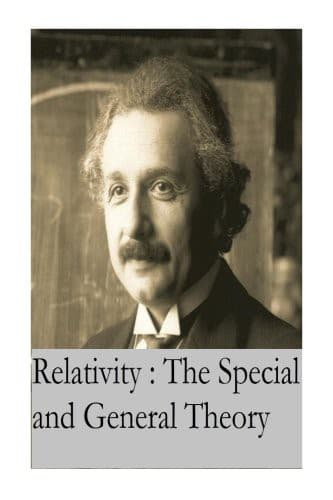
Relativity: The Special and General TheoryEinstein, Albert
Science
Relativity: The Special and General Theory
Einstein, Albert
Relativity (Physics)
proportional to it. Under these conditions, the natural laws satisfying
the demands of the (special) theory of relativity assume mathematical
forms, in which the time co-ordinate plays exactly the same role as the
three space co-ordinates. Formally, these four co-ordinates correspond
exactly to the three space co-ordinates in Euclidean geometry. It must
be clear even to the non-mathematician that, as a consequence of this
purely formal addition to our knowledge, the theory perforce gained
clearness in no mean measure.
[14] Cf. the somewhat more detailed discussion in Appendix II.
These inadequate remarks can give the reader only a vague notion of the
important idea contributed by Minkowski. Without it the general theory
of relativity, of which the fundamental ideas are developed in the
following pages, would perhaps have got no farther than its long
clothes. Minkowski’s work is doubtless difficult of access to anyone
inexperienced in mathematics, but since it is not necessary to have a
very exact grasp of this work in order to understand the fundamental
ideas of either the special or the general theory of relativity, I
shall leave it here at present, and revert to it only towards the end
of Part II.
PART II: THE GENERAL THEORY OF RELATIVITY
XVIII.
SPECIAL AND GENERAL PRINCIPLE OF RELATIVITY
The basal principle, which was the pivot of all our previous
considerations, was the _special_ principle of relativity, _i.e._ the
principle of the physical relativity of all _uniform_ motion. Let as
once more analyse its meaning carefully.
It was at all times clear that, from the point of view of the idea it
conveys to us, every motion must be considered only as a relative
motion. Returning to the illustration we have frequently used of the
embankment and the railway carriage, we can express the fact of the
motion here taking place in the following two forms, both of which are
equally justifiable:
(_a_) The carriage is in motion relative to the embankment,
(_b_) The embankment is in motion relative to the carriage.
In (_a_) the embankment, in (_b_) the carriage, serves as the body of
reference in our statement of the motion taking place. If it is simply
a question of detecting or of describing the motion involved, it is in
principle immaterial to what reference-body we refer the motion. As
already mentioned, this is self-evident, but it must not be confused
with the much more comprehensive statement called “the principle of
relativity,” which we have taken as the basis of our investigations.
The principle we have made use of not only maintains that we may
equally well choose the carriage or the embankment as our
reference-body for the description of any event (for this, too, is
self-evident). Our principle rather asserts what follows: If we
formulate the general laws of nature as they are obtained from
experience, by making use of
(_a_) the embankment as reference-body,
(_b_) the railway carriage as reference-body,
Public-domain text, read in full here on John Shaqi.
Reviews
Reviews
No reviews yet
Be the first to share your thoughts on this work.
Join the Discussion
Join the discussion
Sign in to leave a comment or review.
Sign InorCreate an account