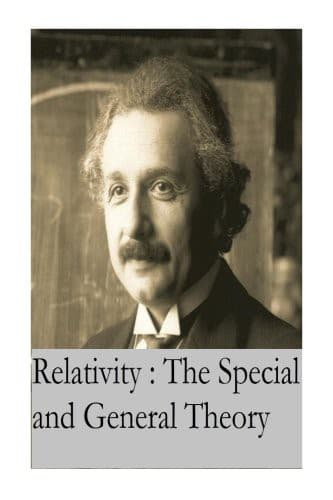
Relativity: The Special and General Theory — John Shaqi
Relativity: The Special and General TheoryEinstein, Albert
Science
Relativity: The Special and General Theory
Einstein, Albert
Relativity (Physics)
then these general laws of nature (_e.g._ the laws of mechanics or the
law of the propagation of light _in vacuo_) have exactly the same form
in both cases. This can also be expressed as follows: For the physical
description of natural processes, neither of the reference bodies _K,
K′_ is unique (lit. “specially marked out”) as compared with the other.
Unlike the first, this latter statement need not of necessity hold _a
priori;_ it is not contained in the conceptions of “motion” and
“reference-body” and derivable from them; only _experience_ can decide
as to its correctness or incorrectness.
Up to the present, however, we have by no means maintained the
equivalence of _all_ bodies of reference _K_ in connection with the
formulation of natural laws. Our course was more on the following
Iines. In the first place, we started out from the assumption that
there exists a reference-body _K_, whose condition of motion is such
that the Galileian law holds with respect to it: A particle left to
itself and sufficiently far removed from all other particles moves
uniformly in a straight line. With reference to K (Galileian
reference-body) the laws of nature were to be as simple as possible.
But in addition to K, all bodies of reference _K′_ should be given
preference in this sense, and they should be exactly equivalent to _K_
for the formulation of natural laws, provided that they are in a state
of _uniform rectilinear and non-rotary motion_ with respect to _K_; all
these bodies of reference are to be regarded as Galileian
reference-bodies. The validity of the principle of relativity was
assumed only for these reference-bodies, but not for others (_e.g._
those possessing motion of a different kind). In this sense we speak of
the _special_ principle of relativity, or special theory of relativity.
In contrast to this we wish to understand by the “general principle of
relativity” the following statement: All bodies of reference _K, K′_,
etc., are equivalent for the description of natural phenomena
(formulation of the general laws of nature), whatever may be their
state of motion. But before proceeding farther, it ought to be pointed
out that this formulation must be replaced later by a more abstract
one, for reasons which will become evident at a later stage.
Public-domain text, read in full here on John Shaqi.
Reviews
Reviews
No reviews yet
Be the first to share your thoughts on this work.
Join the Discussion
Join the discussion
Sign in to leave a comment or review.
Sign InorCreate an account