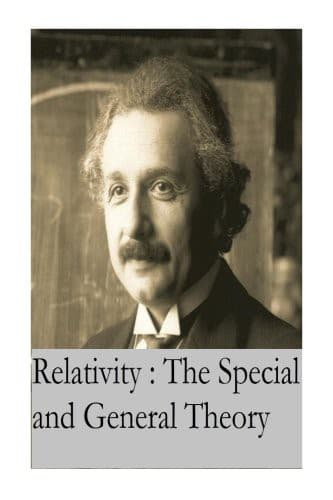
Relativity: The Special and General TheoryEinstein, Albert
Science
Relativity: The Special and General Theory
Einstein, Albert
Relativity (Physics)
But how does the man in the chest regard the Process? The acceleration
of the chest will be transmitted to him by the reaction of the floor of
the chest. He must therefore take up this pressure by means of his legs
if he does not wish to be laid out full length on the floor. He is then
standing in the chest in exactly the same way as anyone stands in a
room of a home on our earth. If he releases a body which he previously
had in his land, the accelertion of the chest will no longer be
transmitted to this body, and for this reason the body will approach
the floor of the chest with an accelerated relative motion. The
observer will further convince himself _that the acceleration of the
body towards the floor of the chest is always of the same magnitude,
whatever kind of body he may happen to use for the experiment._
Relying on his knowledge of the gravitational field (as it was
discussed in the preceding section), the man in the chest will thus
come to the conclusion that he and the chest are in a gravitational
field which is constant with regard to time. Of course he will be
puzzled for a moment as to why the chest does not fall in this
gravitational field. just then, however, he discovers the hook in the
middle of the lid of the chest and the rope which is attached to it,
and he consequently comes to the conclusion that the chest is suspended
at rest in the gravitational field.
Ought we to smile at the man and say that he errs in his conclusion? I
do not believe we ought to if we wish to remain consistent; we must
rather admit that his mode of grasping the situation violates neither
reason nor known mechanical laws. Even though it is being accelerated
with respect to the “Galileian space” first considered, we can
nevertheless regard the chest as being at rest. We have thus good
grounds for extending the principle of relativity to include bodies of
reference which are accelerated with respect to each other, and as a
result we have gained a powerful argument for a generalised postulate
of relativity.
We must note carefully that the possibility of this mode of
interpretation rests on the fundamental property of the gravitational
field of giving all bodies the same acceleration, or, what comes to the
same thing, on the law of the equality of inertial and gravitational
mass. If this natural law did not exist, the man in the accelerated
chest would not be able to interpret the behaviour of the bodies around
him on the supposition of a gravitational field, and he would not be
justified on the grounds of experience in supposing his reference-body
to be “at rest.”
Public-domain text, read in full here on John Shaqi.
Reviews
Reviews
No reviews yet
Be the first to share your thoughts on this work.
Join the Discussion
Join the discussion
Sign in to leave a comment or review.
Sign InorCreate an account