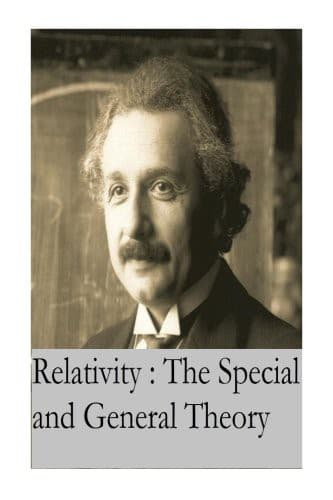
Relativity: The Special and General TheoryEinstein, Albert
Science
Relativity: The Special and General Theory
Einstein, Albert
Relativity (Physics)
Suppose that the man in the chest fixes a rope to the inner side of the
lid, and that he attaches a body to the free end of the rope. The
result of this will be to stretch the rope so that it will hang
“vertically” downwards. If we ask for an opinion of the cause of
tension in the rope, the man in the chest will say: “The suspended body
experiences a downward force in the gravitational field, and this is
neutralised by the tension of the rope; what determines the magnitude
of the tension of the rope is the _gravitational mass_ of the suspended
body.” On the other hand, an observer who is poised freely in space
will interpret the condition of things thus: “The rope must perforce
take part in the accelerated motion of the chest, and it transmits this
motion to the body attached to it. The tension of the rope is just
large enough to effect the acceleration of the body. That which
determines the magnitude of the tension of the rope is the _inertial
mass_ of the body.” Guided by this example, we see that our extension
of the principle of relativity implies the _necessity_ of the law of
the equality of inertial and gravitational mass. Thus we have obtained
a physical interpretation of this law.
From our consideration of the accelerated chest we see that a general
theory of relativity must yield important results on the laws of
gravitation. In point of fact, the systematic pursuit of the general
idea of relativity has supplied the laws satisfied by the gravitational
field. Before proceeding farther, however, I must warn the reader
against a misconception suggested by these considerations. A
gravitational field exists for the man in the chest, despite the fact
that there was no such field for the co-ordinate system first chosen.
Now we might easily suppose that the existence of a gravitational field
is always only an _apparent_ one. We might also think that, regardless
of the kind of gravitational field which may be present, we could
always choose another reference-body such that _no_ gravitational field
exists with reference to it. This is by no means true for all
gravitational fields, but only for those of quite special form. It is,
for instance, impossible to choose a body of reference such that, as
judged from it, the gravitational field of the earth (in its entirety)
vanishes.
Public-domain text, read in full here on John Shaqi.
Reviews
Reviews
No reviews yet
Be the first to share your thoughts on this work.
Join the Discussion
Join the discussion
Sign in to leave a comment or review.
Sign InorCreate an account