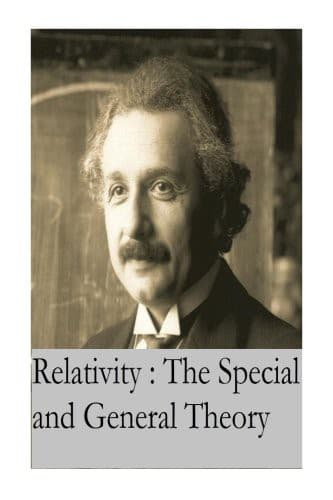
Relativity: The Special and General TheoryEinstein, Albert
Science
Relativity: The Special and General Theory
Einstein, Albert
Relativity (Physics)
We can now appreciate why that argument is not convincing, which we
brought forward against the general principle of relativity at the end
of Section XVIII. It is certainly true that the observer in the railway
carriage experiences a jerk forwards as a result of the application of
the brake, and that he recognises, in this the non-uniformity of motion
(retardation) of the carriage. But he is compelled by nobody to refer
this jerk to a “real” acceleration (retardation) of the carriage. He
might also interpret his experience thus: “My body of reference (the
carriage) remains permanently at rest. With reference to it, however,
there exists (during the period of application of the brakes) a
gravitational field which is directed forwards and which is variable
with respect to time. Under the influence of this field, the embankment
together with the earth moves non-uniformly in such a manner that their
original velocity in the backwards direction is continuously reduced.”
XXI.
IN WHAT RESPECTS ARE THE FOUNDATIONS OF CLASSICAL MECHANICS AND OF THE
SPECIAL THEORY OF RELATIVITY UNSATISFACTORY?
We have already stated several times that classical mechanics starts
out from the following law: Material particles sufficiently far removed
from other material particles continue to move uniformly in a straight
line or continue in a state of rest. We have also repeatedly emphasised
that this fundamental law can only be valid for bodies of reference _K_
which possess certain unique states of motion, and which are in uniform
translational motion relative to each other. Relative to other
reference-bodies _K_ the law is not valid. Both in classical mechanics
and in the special theory of relativity we therefore differentiate
between reference-bodies _K_ relative to which the recognised “laws of
nature” can be said to hold, and reference-bodies _K_ relative to which
these laws do not hold.
But no person whose mode of thought is logical can rest satisfied with
this condition of things. He asks: “How does it come that certain
reference-bodies (or their states of motion) are given priority over
other reference-bodies (or their states of motion)? _What is the reason
for this preference?_” In order to show clearly what I mean by this
question, I shall make use of a comparison.
Public-domain text, read in full here on John Shaqi.
Reviews
Reviews
No reviews yet
Be the first to share your thoughts on this work.
Join the Discussion
Join the discussion
Sign in to leave a comment or review.
Sign InorCreate an account