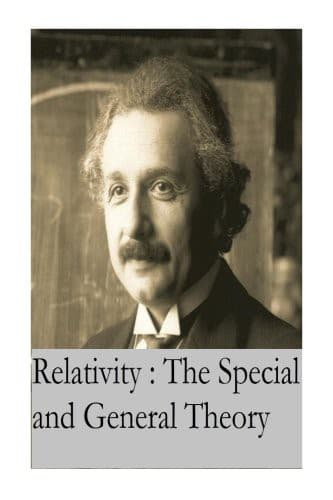
Relativity: The Special and General Theory — John Shaqi
Relativity: The Special and General TheoryEinstein, Albert
Science
Relativity: The Special and General Theory
Einstein, Albert
Relativity (Physics)
We start off again from quite special cases, which we have frequently
used before. Let us consider a space time domain in which no
gravitational field exists relative to a reference-body _K_ whose state
of motion has been suitably chosen. _K_ is then a Galileian
reference-body as regards the domain considered, and the results of the
special theory of relativity hold relative to _K_. Let us suppose the
same domain referred to a second body of reference _K′_, which is
rotating uniformly with respect to _K_. In order to fix our ideas, we
shall imagine _K′_ to be in the form of a plane circular disc, which
rotates uniformly in its own plane about its centre. An observer who is
sitting eccentrically on the disc _K′_ is sensible of a force which
acts outwards in a radial direction, and which would be interpreted as
an effect of inertia (centrifugal force) by an observer who was at rest
with respect to the original reference-body _K_. But the observer on
the disc may regard his disc as a reference-body which is “at rest”; on
the basis of the general principle of relativity he is justified in
doing this. The force acting on himself, and in fact on all other
bodies which are at rest relative to the disc, he regards as the effect
of a gravitational field. Nevertheless, the space-distribution of this
gravitational field is of a kind that would not be possible on Newton’s
theory of gravitation.[18] But since the observer believes in the
general theory of relativity, this does not disturb him; he is quite in
the right when he believes that a general law of gravitation can be
formulated—a law which not only explains the motion of the stars
correctly, but also the field of force experienced by himself.
[18] The field disappears at the centre of the disc and increases
proportionally to the distance from the centre as we proceed outwards.
The observer performs experiments on his circular disc with clocks and
measuring-rods. In doing so, it is his intention to arrive at exact
definitions for the signification of time- and space-data with
reference to the circular disc _K′_, these definitions being based on
his observations. What will be his experience in this enterprise?
Public-domain text, read in full here on John Shaqi.
Reviews
Reviews
No reviews yet
Be the first to share your thoughts on this work.
Join the Discussion
Join the discussion
Sign in to leave a comment or review.
Sign InorCreate an account