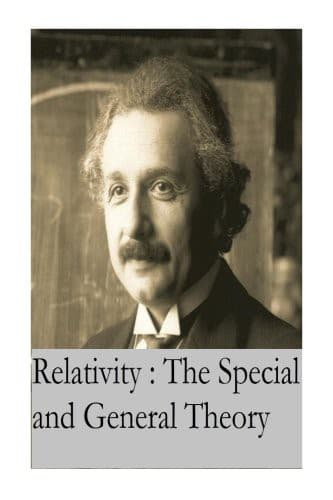
Relativity: The Special and General TheoryEinstein, Albert
Science
Relativity: The Special and General Theory
Einstein, Albert
Relativity (Physics)
To start with, he places one of two identically constructed clocks at
the centre of the circular disc, and the other on the edge of the disc,
so that they are at rest relative to it. We now ask ourselves whether
both clocks go at the same rate from the standpoint of the non-rotating
Galileian reference-body _K_. As judged from this body, the clock at
the centre of the disc has no velocity, whereas the clock at the edge
of the disc is in motion relative to _K_ in consequence of the
rotation. According to a result obtained in Section XII, it follows
that the latter clock goes at a rate permanently slower than that of
the clock at the centre of the circular disc, _i.e._ as observed from
_K_. It is obvious that the same effect would be noted by an observer
whom we will imagine sitting alongside his clock at the centre of the
circular disc. Thus on our circular disc, or, to make the case more
general, in every gravitational field, a clock will go more quickly or
less quickly, according to the position in which the clock is situated
(at rest). For this reason it is not possible to obtain a reasonable
definition of time with the aid of clocks which are arranged at rest
with respect to the body of reference. A similar difficulty presents
itself when we attempt to apply our earlier definition of simultaneity
in such a case, but I do not wish to go any farther into this question.
Moreover, at this stage the definition of the space co-ordinates also
presents insurmountable difficulties. If the observer applies his
standard measuring-rod (a rod which is short as compared with the
radius of the disc) tangentially to the edge of the disc, then, as
judged from the Galileian system, the length of this rod will be less
than 1, since, according to Section XII, moving bodies suffer a
shortening in the direction of the motion. On the other hand, the
measuring-rod will not experience a shortening in length, as judged
from _K_, if it is applied to the disc in the direction of the radius.
If, then, the observer first measures the circumference of the disc
with his measuring-rod and then the diameter of the disc, on dividing
the one by the other, he will not obtain as quotient the familiar
number π = 3.14 . . ., but a larger number,[19] whereas of course, for
a disc which is at rest with respect to _K_, this operation would yield
π exactly. This proves that the propositions of Euclidean geometry
cannot hold exactly on the rotating disc, nor in general in a
gravitational field, at least if we attribute the length 1 to the rod
in all positions and in every orientation. Hence the idea of a straight
line also loses its meaning. We are therefore not in a position to
define exactly the co-ordinates _x, y, z_ relative to the disc by means
of the method used in discussing the special theory, and as long as the
co-ordinates and times of events have not been defined, we cannot
assign an exact meaning to the natural laws in which these occur.
Public-domain text, read in full here on John Shaqi.
Reviews
Reviews
No reviews yet
Be the first to share your thoughts on this work.
Join the Discussion
Join the discussion
Sign in to leave a comment or review.
Sign InorCreate an account