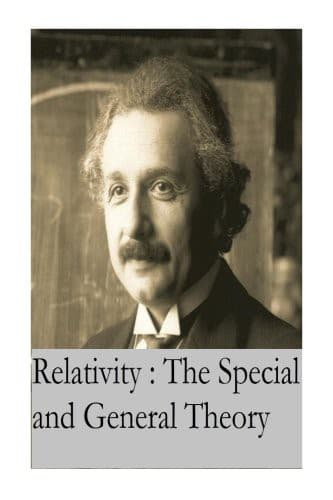
Relativity: The Special and General TheoryEinstein, Albert
Science
Relativity: The Special and General Theory
Einstein, Albert
Relativity (Physics)
But the considerations of Sections XXV and XXVI show us the way to
surmount this difficulty. We refer the four-dimensional space-time
continuum in an arbitrary manner to Gauss co-ordinates. We assign to
every point of the continuum (event) four numbers, _x_1, _x_2, _x_3,
_x_4 (co-ordinates), which have not the least direct physical
significance, but only serve the purpose of numbering the points of the
continuum in a definite but arbitrary manner. This arrangement does not
even need to be of such a kind that we must regard _x_1, _x_2, _x_3, as
“space” co-ordinates and _x_4, as a “time” co-ordinate.
The reader may think that such a description of the world would be
quite inadequate. What does it mean to assign to an event the
particular co-ordinates _x_1, _x_2, _x_3, _x_4, if in themselves these
co-ordinates have no significance? More careful consideration shows,
however, that this anxiety is unfounded. Let us consider, for instance,
a material point with any kind of motion. If this point had only a
momentary existence without duration, then it would to described in
space-time by a single system of values _x_1, _x_2, _x_3, _x_4. Thus
its permanent existence must be characterised by an infinitely large
number of such systems of values, the co-ordinate values of which are
so close together as to give continuity; corresponding to the material
point, we thus have a (uni-dimensional) line in the four-dimensional
continuum. In the same way, any such lines in our continuum correspond
to many points in motion. The only statements having regard to these
points which can claim a physical existence are in reality the
statements about their encounters. In our mathematical treatment, such
an encounter is expressed in the fact that the two lines which
represent the motions of the points in question have a particular
system of co-ordinate values, _x_1, _x_2, _x_3, _x_4, in common. After
mature consideration the reader will doubtless admit that in reality
such encounters constitute the only actual evidence of a time-space
nature with which we meet in physical statements.
When we were describing the motion of a material point relative to a
body of reference, we stated nothing more than the encounters of this
point with particular points of the reference-body. We can also
determine the corresponding values of the time by the observation of
encounters of the body with clocks, in conjunction with the observation
of the encounter of the hands of clocks with particular points on the
dials. It is just the same in the case of space-measurements by means
of measuring-rods, as a little consideration will show.
Public-domain text, read in full here on John Shaqi.
Reviews
Reviews
No reviews yet
Be the first to share your thoughts on this work.
Join the Discussion
Join the discussion
Sign in to leave a comment or review.
Sign InorCreate an account