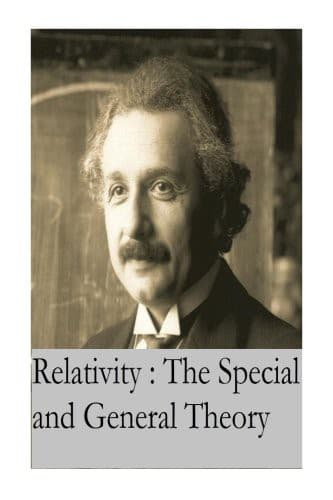
Relativity: The Special and General TheoryEinstein, Albert
Science
Relativity: The Special and General Theory
Einstein, Albert
Relativity (Physics)
The following statements hold generally: Every physical description
resolves itself into a number of statements, each of which refers to
the space-time coincidence of two events _A_ and _B_. In terms of
Gaussian co-ordinates, every such statement is expressed by the
agreement of their four co-ordinates _x_1, _x_2, _x_3, _x_4. Thus in
reality, the description of the time-space continuum by means of Gauss
co-ordinates completely replaces the description with the aid of a body
of reference, without suffering from the defects of the latter mode of
description; it is not tied down to the Euclidean character of the
continuum which has to be represented.
XXVIII.
EXACT FORMULATION OF THE GENERAL PRINCIPLE OF RELATIVITY
We are now in a position to replace the provisional formulation of the
general principle of relativity given in Section XVIII by an exact
formulation. The form there used, “All bodies of reference _K, K′_,
etc., are equivalent for the description of natural phenomena
(formulation of the general laws of nature), whatever may be their
state of motion,” cannot be maintained, because the use of rigid
reference-bodies, in the sense of the method followed in the special
theory of relativity, is in general not possible in space-time
description. The Gauss co-ordinate system has to take the place of the
body of reference. The following statement corresponds to the
fundamental idea of the general principle of relativity: “_All Gaussian
co-ordinate systems are essentially equivalent for the formulation of
the general laws of nature._”
We can state this general principle of relativity in still another
form, which renders it yet more clearly intelligible than it is when in
the form of the natural extension of the special principle of
relativity. According to the special theory of relativity, the
equations which express the general laws of nature pass over into
equations of the same form when, by making use of the Lorentz
transformation, we replace the space-time variables _x, y, z, t_, of a
(Galileian) reference-body _K_ by the space-time variables _x′, y′, z′,
t′_, of a new reference-body _K′_. According to the general theory of
relativity, on the other hand, by application of _arbitrary
substitutions_ of the Gauss variables _x_1, _x_2, _x_3, _x_4, the
equations must pass over into equations of the same form; for every
transformation (not only the Lorentz transformation) corresponds to the
transition of one Gauss co-ordinate system into another.
Public-domain text, read in full here on John Shaqi.
Reviews
Reviews
No reviews yet
Be the first to share your thoughts on this work.
Join the Discussion
Join the discussion
Sign in to leave a comment or review.
Sign InorCreate an account