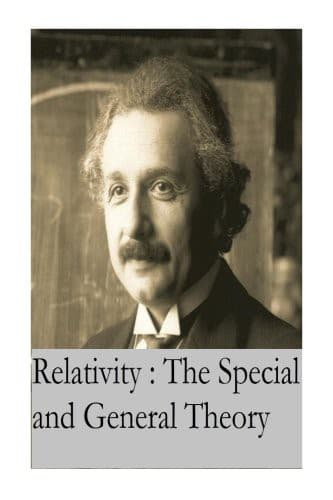
Relativity: The Special and General TheoryEinstein, Albert
Science
Relativity: The Special and General Theory
Einstein, Albert
Relativity (Physics)
[24] _Proof_—According to the theory of Newton, the number of “lines
of force” which come from infinity and terminate in a mass m is
proportional to the mass _m_. If, on the average, the mass density ρ0
is constant throughout the universe, then a sphere of volume _V_ will
enclose the average mass ρ0_V_. Thus the number of lines of force
passing through the surface _F_ of the sphere into its interior is
proportional to ρ0_V_. For unit area of the surface of the sphere the
number of lines of force which enters the sphere is thus proportional
to ρ0_V/F_ or to ρ0_R_. Hence the intensity of the field at the
surface would ultimately become infinite with increasing radius _R_ of
the sphere, which is impossible.
This conception is in itself not very satisfactory. It is still less
satisfactory because it leads to the result that the light emitted by
the stars and also individual stars of the stellar system are
perpetually passing out into infinite space, never to return, and
without ever again coming into interaction with other objects of
nature. Such a finite material universe would be destined to become
gradually but systematically impoverished.
In order to escape this dilemma, Seeliger suggested a modification of
Newton’s law, in which he assumes that for great distances the force of
attraction between two masses diminishes more rapidly than would result
from the inverse square law. In this way it is possible for the mean
density of matter to be constant everywhere, even to infinity, without
infinitely large gravitational fields being produced. We thus free
ourselves from the distasteful conception that the material universe
ought to possess something of the nature of a centre. Of course we
purchase our emancipation from the fundamental difficulties mentioned,
at the cost of a modification and complication of Newton’s law which
has neither empirical nor theoretical foundation. We can imagine
innumerable laws which would serve the same purpose, without our being
able to state a reason why one of them is to be preferred to the
others; for any one of these laws would be founded just as little on
more general theoretical principles as is the law of Newton.
XXXI.
THE POSSIBILITY OF A “FINITE” AND YET “UNBOUNDED” UNIVERSE
But speculations on the structure of the universe also move in quite
another direction. The development of non-Euclidean geometry led to the
recognition of the fact, that we can cast doubt on the _infiniteness_
of our space without coming into conflict with the laws of thought or
with experience (Riemann, Helmholtz). These questions have already been
treated in detail and with unsurpassable lucidity by Helmholtz and
Poincaré, whereas I can only touch on them briefly here.
Public-domain text, read in full here on John Shaqi.
Reviews
Reviews
No reviews yet
Be the first to share your thoughts on this work.
Join the Discussion
Join the discussion
Sign in to leave a comment or review.
Sign InorCreate an account