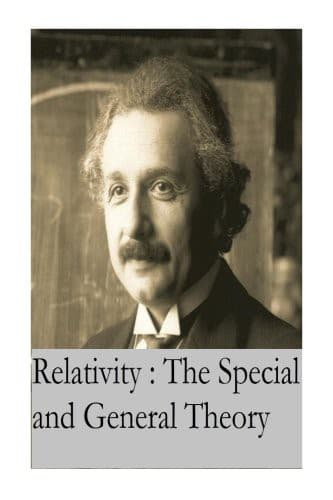
Relativity: The Special and General TheoryEinstein, Albert
Science
Relativity: The Special and General Theory
Einstein, Albert
Relativity (Physics)
On the basis of the general theory of relativity, it is found that the
ellipse of every planet round the sun must necessarily rotate in the
manner indicated above; that for all the planets, with the exception of
Mercury, this rotation is too small to be detected with the delicacy of
observation possible at the present time; but that in the case of
Mercury it must amount to 43 seconds of arc per century, a result which
is strictly in agreement with observation.
Apart from this one, it has hitherto been possible to make only two
deductions from the theory which admit of being tested by observation,
to wit, the curvature of light rays by the gravitational field of the
sun,[22] and a displacement of the spectral lines of light reaching us
from large stars, as compared with the corresponding lines for light
produced in an analogous manner terrestrially (_i.e._ by the same kind
of atom).[23] These two deductions from the theory have both been
confirmed.
[22] First observed by Eddington and others in 1919. (Cf. Appendix
III).
[23] Established by Adams in 1924. (Cf. p. 132)
PART III: CONSIDERATIONS ON THE UNIVERSE AS A WHOLE
XXX.
COSMOLOGICAL DIFFICULTIES OF NEWTON’S THEORY
Part from the difficulty discussed in Section XXI, there is a second
fundamental difficulty attending classical celestial mechanics, which,
to the best of my knowledge, was first discussed in detail by the
astronomer Seeliger. If we ponder over the question as to how the
universe, considered as a whole, is to be regarded, the first answer
that suggests itself to us is surely this: As regards space (and time)
the universe is infinite. There are stars everywhere, so that the
density of matter, although very variable in detail, is nevertheless on
the average everywhere the same. In other words: However far we might
travel through space, we should find everywhere an attenuated swarm of
fixed stars of approrimately the same kind and density.
This view is not in harmony with the theory of Newton. The latter
theory rather requires that the universe should have a kind of centre
in which the density of the stars is a maximum, and that as we proceed
outwards from this centre the group-density of the stars should
diminish, until finally, at great distances, it is succeeded by an
infinite region of emptiness. The stellar universe ought to be a finite
island in the infinite ocean of space.[24]
Public-domain text, read in full here on John Shaqi.
Reviews
Reviews
No reviews yet
Be the first to share your thoughts on this work.
Join the Discussion
Join the discussion
Sign in to leave a comment or review.
Sign InorCreate an account