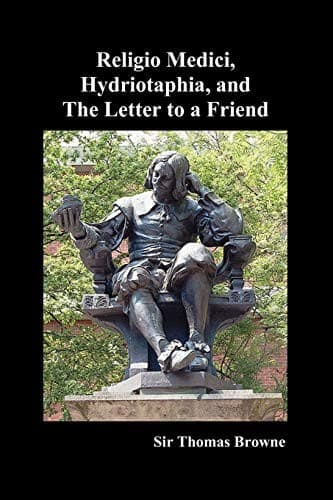
Religio Medici, Hydriotaphia, and the Letter to a Friend — John Shaqi
Religio Medici, Hydriotaphia, and the Letter to a FriendBrowne, Thomas, Sir
Religion
Religio Medici, Hydriotaphia, and the Letter to a Friend
Browne, Thomas, Sir
Christian ethics; Christian life; Essays; Funeral rites and ceremonies; Medical ethics; Medicine -- History; Religion and medicine
Produced by Henry Flower and Judith Boss, Omaha, Nebraska
Transcriber's Note
The printed text contained both footnotes and endnotes. These have
been renumbered in continuous series of letters and Arabic numerals
respectively.
Corrected errata are listed at the end of the text.
The following List of Contents has been added by the transcriber:
RELIGIO MEDICI
HYDRIOTAPHIA
A LETTER TO A FRIEND
NOTES TO THE RELIGIO MEDICI
NOTES TO HYDRIOTAPHIA
NOTES TO LETTER TO A FRIEND
RELIGIO MEDICI.
_RELIGIO MEDICI_,
HYDRIOTAPHIA, AND THE LETTER TO A FRIEND.
BY
SIR THOMAS BROWNE, KNT.
WITH AN INTRODUCTION AND NOTES BY
J. W. WILLIS BUND, M.A., LL.B.,
GONVILLE AND CAIUS COLLEGE, CAMBRIDGE,
OF LINCOLN’S INN, BARRISTER-AT-LAW.
LONDON:
SAMPSON LOW, SON, AND MARSTON,
CROWN BUILDINGS, 188 FLEET STREET.
1869.
INTRODUCTION.
SIR THOMAS BROWNE (whose works occupy so prominent a position in the
literary history of the seventeenth century) is an author who is now
little known and less read. This comparative oblivion to which he has
been consigned is the more remarkable, as, if for nothing else, his
writings deserve to be studied as an example of the English language
in what may be termed a transition state. The prose of the Elizabethan
age was beginning to pass away and give place to a more inflated style
of writing--a style which, after passing through various stages of
development, culminated in that of Johnson.
Browne is one of the best early examples of this school; his style,
to quote Johnson himself, “is vigorous but rugged, it is learned but
pedantick, it is deep but obscure, it strikes but does not please, it
commands but does not allure. . . . It is a tissue of many languages, a
mixture of heterogeneous words brought together from distant regions.”
Yet in spite of this qualified censure, there are passages in Browne’s
works not inferior to any in the English language; and though his
writings may not be “a well of English undefiled,” yet it is the very
defilements that add to the beauty of the work.
But it is not only as an example of literary style that Browne deserves
to be studied. The matter of his works, the grandeur of his ideas, the
originality of his thoughts, the greatness of his charity, amply make
up for the deficiencies (if deficiencies there be) in his style. An
author who combined the wit of Montaigne with the learning of Erasmus,
and of whom even Hallam could say that “his varied talents wanted
nothing but the controlling supremacy of good sense to place him in the
highest rank of our literature,” should not be suffered to remain in
obscurity.
A short account of his life will form the best introduction to his
works.
Public-domain text, read in full here on John Shaqi.
Reviews
Reviews
No reviews yet
Be the first to share your thoughts on this work.
Join the Discussion
Join the discussion
Sign in to leave a comment or review.
Sign InorCreate an account