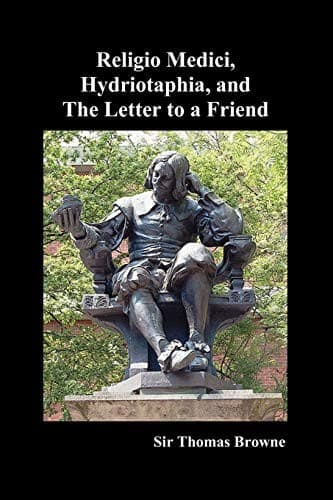
Religio Medici, Hydriotaphia, and the Letter to a Friend — John Shaqi
Religio Medici, Hydriotaphia, and the Letter to a FriendBrowne, Thomas, Sir
Religion
Religio Medici, Hydriotaphia, and the Letter to a Friend
Browne, Thomas, Sir
Christian ethics; Christian life; Essays; Funeral rites and ceremonies; Medical ethics; Medicine -- History; Religion and medicine
Sir Thomas Browne was born in London, in the parish of St Michael le
Quern, on the 19th of October 1605. His father was a London merchant,
of a good Cheshire family; and his mother a Sussex lady, daughter of Mr
Paul Garraway of Lewis. His father died when he was very young, and his
mother marrying again shortly afterwards, Browne was left to the care
of his guardians, one of whom is said to have defrauded him out of some
of his property. He was educated at Winchester, and afterwards sent
to Oxford, to what is now Pembroke College, where he took his degree
of M.A. in 1629. Thereupon he commenced for a short time to practise
as a physician in Oxfordshire. But we soon find him growing tired of
this, and accompanying his father-in-law, Sir Thomas Dutton, on a
tour of inspection of the castles and forts in Ireland. We next hear
of Browne in the south of France, at Montpellier, then a celebrated
school of medicine, where he seems to have studied some little time.
From there he proceeded to Padua, one of the most famous of the Italian
universities, and noted for the views some of its members held on the
subjects of astronomy and necromancy. During his residence here, Browne
doubtless acquired some of his peculiar ideas on the science of the
heavens and the black art, and, what was more important, he learnt to
regard the Romanists with that abundant charity we find throughout his
works. From Padua, Browne went to Leyden, and this sudden change from
a most bigoted Roman Catholic to a most bigoted Protestant country
was not without its effect on his mind, as can be traced in his book.
Here he took the degree of Doctor of Medicine, and shortly afterwards
returned to England. Soon after his return, about the year 1635, he
published his “Religio Medici,” his first and greatest work, which
may be fairly regarded as the reflection of the mind of one who, in
spite of a strong intellect and vast erudition, was still prone to
superstition, but having
“Through many cities strayed,
Their customs, laws, and manners weighed,”
had obtained too large views of mankind to become a bigot.
After the publication of his book he settled at Norwich, where he soon
had an extensive practice as a physician. From hence there remains
little to be told of his life. In 1637 he was incorporated Doctor of
Medicine at Oxford; and in 1641 he married Dorothy the daughter of
Edward Mileham, of Burlingham in Norfolk, and had by her a family of
eleven children.
In 1646 he published his “Pseudodoxia Epidemica,” or Enquiries into
Vulgar Errors. The discovery of some Roman urns at Burnham in Norfolk,
led him in 1658 to write his “Hydriotaphia” (Urn-burial); he also
published at the same time “The Garden of Cyrus, or the Quincunxcial
Lozenge of the Ancients,” a curious work, but far inferior to his other
productions.
In 1665 he was elected an honorary Fellow of the College of Physicians,
“virtute et literis ornatissimus.”
Public-domain text, read in full here on John Shaqi.
Reviews
Reviews
No reviews yet
Be the first to share your thoughts on this work.
Join the Discussion
Join the discussion
Sign in to leave a comment or review.
Sign InorCreate an account