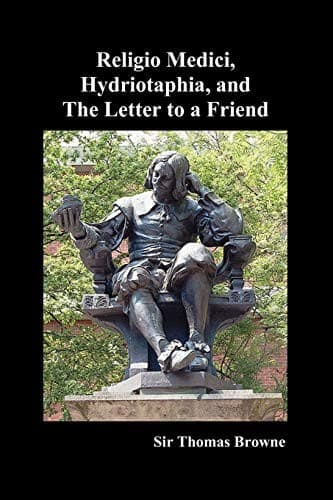
Religio Medici, Hydriotaphia, and the Letter to a FriendBrowne, Thomas, Sir
Religion
Religio Medici, Hydriotaphia, and the Letter to a Friend
Browne, Thomas, Sir
Christian ethics; Christian life; Essays; Funeral rites and ceremonies; Medical ethics; Medicine -- History; Religion and medicine
Nor were only many customs questionable in order to their obsequies,
but also sundry practices, fictions, and conceptions, discordant or
obscure, of their state and future beings. Whether unto eight or ten
bodies of men to add one of a woman, as being more inflammable and
unctuously constituted for the better pyral combustion, were any
rational practice; or whether the complaint of Periander’s wife be
tolerable, that wanting her funeral burning, she suffered intolerable
cold in hell, according to the constitution of the infernal house of
Pluto, wherein cold makes a great part of their tortures; it cannot
pass without some question.
Why the female ghosts appear unto Ulysses, before the heroes and
masculine spirits,--why the Psyche or soul of Tiresias is of the
masculine gender, who, being blind on earth, sees more than all the
rest in hell; why the funeral suppers consisted of eggs, beans,
smallage, and lettuce, since the dead are made to eat asphodels about
the Elysian meadows:--why, since there is no sacrifice acceptable, nor
any propitiation for the covenant of the grave, men set up the deity of
Morta, and fruitlessly adored divinities without ears, it cannot escape
some doubt.
The dead seem all alive in the human Hades of Homer, yet cannot well
speak, prophecy, or know the living, except they drink blood, wherein
is the life of man. And therefore the souls of Penelope’s paramours,
conducted by Mercury, chirped like bats, and those which followed
Hercules, made a noise but like a flock of birds.
The departed spirits know things past and to come; yet are ignorant of
things present. Agamemnon foretells what should happen unto Ulysses;
yet ignorantly inquires what is become of his own son. The ghosts are
afraid of swords in Homer; yet Sibylla tells Æneas in Virgil, the thin
habit of spirits was beyond the force of weapons. The spirits put off
their malice with their bodies, and Cæsar and Pompey accord in Latin
hell; yet Ajax, in Homer, endures not a conference with Ulysses; and
Deiphobus appears all mangled in Virgil’s ghosts, yet we meet with
perfect shadows among the wounded ghosts of Homer.
Since Charon in Lucian applauds his condition among the dead, whether
it be handsomely said of Achilles, that living contemner of death, that
he had rather be a ploughman’s servant, than emperor of the dead? How
Hercules his soul is in hell, and yet in heaven; and Julius his soul in
a star, yet seen by Æneas in hell?--except the ghosts were but images
and shadows of the soul, received in higher mansions, according to the
ancient division of body, soul, and image, or _simulachrum_ of them
both. The particulars of future beings must needs be dark unto ancient
theories, which Christian philosophy yet determines but in a cloud of
opinions. A dialogue between two infants in the womb concerning the
state of this world, might handsomely illustrate our ignorance of the
next, whereof methinks we yet discourse in Pluto’s den, and are but
embryo philosophers.
Public-domain text, read in full here on John Shaqi.
Reviews
Reviews
No reviews yet
Be the first to share your thoughts on this work.
Elsewhere in the archive
Join the Discussion
Join the discussion
Sign in to leave a comment or review.
Sign InorCreate an account