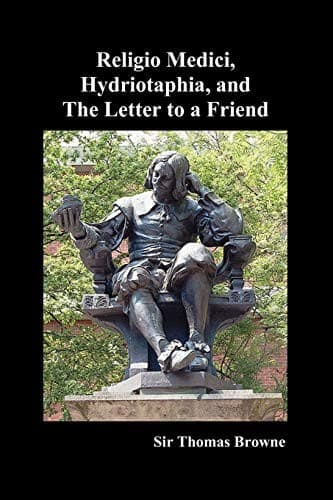
Religio Medici, Hydriotaphia, and the Letter to a FriendBrowne, Thomas, Sir
Religion
Religio Medici, Hydriotaphia, and the Letter to a Friend
Browne, Thomas, Sir
Christian ethics; Christian life; Essays; Funeral rites and ceremonies; Medical ethics; Medicine -- History; Religion and medicine
But all or most apprehensions rested in opinions of some future
being, which, ignorantly or coldly believed, begat those perverted
conceptions, ceremonies, sayings, which Christians pity or laugh at.
Happy are they which live not in that disadvantage of time, when men
could say little for futurity, but from reason: whereby the noblest
minds fell often upon doubtful deaths, and melancholy dissolutions.
With these hopes, Socrates warmed his doubtful spirits against that
cold potion; and Cato, before he durst give the fatal stroke, spent
part of the night in reading the Immortality of Plato, thereby
confirming his wavering hand unto the animosity of that attempt.
It is the heaviest stone that melancholy can throw at a man, to tell
him he is at the end of his nature; or that there is no further state
to come, unto which this seems progressional, and otherwise made
in vain. Without this accomplishment, the natural expectation and
desire of such a state, were but a fallacy in nature; unsatisfied
considerators would quarrel the justice of their constitutions, and
rest content that Adam had fallen lower; whereby, by knowing no other
original, and deeper ignorance of themselves, they might have enjoyed
the happiness of inferior creatures, who in tranquillity possess their
constitutions, as having not the apprehension to deplore their own
natures, and, being framed below the circumference of these hopes,
or cognition of better being, the wisdom of God hath necessitated
their contentment: but the superior ingredient and obscured part
of ourselves, whereto all present felicities afford no resting
contentment, will be able at last to tell us, we are more than our
present selves, and evacuate such hopes in the fruition of their own
accomplishments.
CHAPTER V.
Now since these dead bones have already outlasted the living ones of
Methuselah, and in a yard underground, and thin walls of clay, outworn
all the strong and specious buildings above it; and quietly rested
under the drums and tramplings of three conquests: what prince can
promise such diuturnity unto his relicks, or might not gladly say,
_Sic ego componi versus in ossa velim?_[BP]
[BP] _Tibullus_, lib. iii. el. 2, 26.
Time, which antiquates antiquities, and hath an art to make dust of all
things, hath yet spared these minor monuments.
Public-domain text, read in full here on John Shaqi.
Reviews
Reviews
No reviews yet
Be the first to share your thoughts on this work.
Elsewhere in the archive
Join the Discussion
Join the discussion
Sign in to leave a comment or review.
Sign InorCreate an account