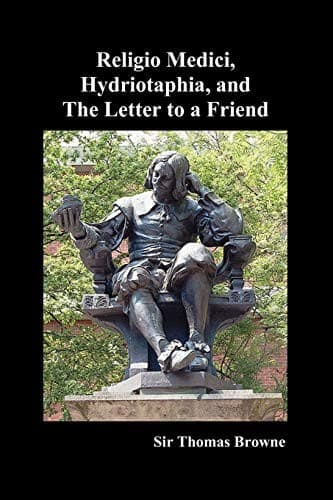
Religio Medici, Hydriotaphia, and the Letter to a FriendBrowne, Thomas, Sir
Religion
Religio Medici, Hydriotaphia, and the Letter to a Friend
Browne, Thomas, Sir
Christian ethics; Christian life; Essays; Funeral rites and ceremonies; Medical ethics; Medicine -- History; Religion and medicine
In vain we hope to be known by open and visible conservatories, when
to be unknown was the means of their continuation, and obscurity their
protection. If they died by violent hands, and were thrust into their
urns, these bones become considerable, and some old philosophers would
honour them, whose souls they conceived most pure, which were thus
snatched from their bodies, and to retain a stronger propension unto
them; whereas they weariedly left a languishing corpse and with faint
desires of re-union. If they fell by long and aged decay, yet wrapt
up in the bundle of time, they fall into indistinction, and make but
one blot with infants. If we begin to die when we live, and long life
be but a prolongation of death, our life is a sad composition; we
live with death, and die not in a moment. How many pulses made up the
life of Methuselah, were work for Archimedes: common counters sum up
the life of Moses his man. Our days become considerable, like petty
sums, by minute accumulations: where numerous fractions make up but
small round numbers; and our days of a span long, make not one little
finger.[BQ]
[BQ] According to the ancient arithmetick of the hand, wherein
the little finger of the right hand contracted, signified an
hundred.--_Pierius in Hieroglyph._
If the nearness of our last necessity brought a nearer conformity
into it, there were a happiness in hoary hairs, and no calamity in
half-senses. But the long habit of living indisposeth us for dying;
when avarice makes us the sport of death, when even David grew
politickly cruel, and Solomon could hardly be said to be the wisest of
men. But many are too early old, and before the date of age. Adversity
stretcheth our days, misery makes Alcmena’s nights,[BR] and time hath
no wings unto it. But the most tedious being is that which can unwish
itself, content to be nothing, or never to have been, which was beyond
the malcontent of Job, who cursed not the day of his life, but his
nativity; content to have so far been, as to have a title to future
being, although he had lived here but in an hidden state of life, and
as it were an abortion.
[BR] One night as long as three.
Public-domain text, read in full here on John Shaqi.
Reviews
Reviews
No reviews yet
Be the first to share your thoughts on this work.
Elsewhere in the archive
Join the Discussion
Join the discussion
Sign in to leave a comment or review.
Sign InorCreate an account