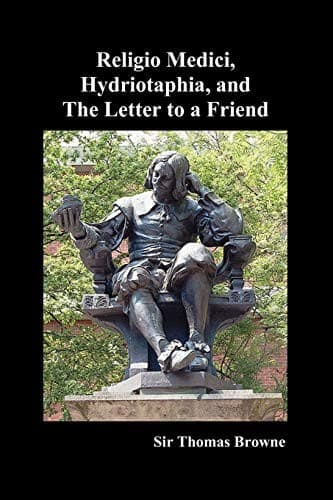
Religio Medici, Hydriotaphia, and the Letter to a FriendBrowne, Thomas, Sir
Religion
Religio Medici, Hydriotaphia, and the Letter to a Friend
Browne, Thomas, Sir
Christian ethics; Christian life; Essays; Funeral rites and ceremonies; Medical ethics; Medicine -- History; Religion and medicine
What song the Syrens sang, or what name Achilles assumed when he hid
himself among women, though puzzling questions,[BS] are not beyond
all conjecture. What time the persons of these ossuaries entered the
famous nations of the dead, and slept with princes and counsellors,
might admit a wide solution. But who were the proprietaries of
these bones, or what bodies these ashes made up, were a question
above antiquarism; not to be resolved by man, nor easily perhaps by
spirits, except we consult the provincial guardians, or tutelary
observators. Had they made as good provision for their names, as they
have done for their relicks, they had not so grossly erred in the
art of perpetuation. But to subsist in bones, and be but pyramidally
extant, is a fallacy in duration. Vain ashes which in the oblivion
of names, persons, times, and sexes, have found unto themselves a
fruitless continuation, and only arise unto late posterity, as emblems
of mortal vanities, antidotes against pride, vain-glory, and madding
vices. Pagan vain-glories which thought the world might last for ever,
had encouragement for ambition; and, finding no _atropos_ unto the
immortality of their names, were never dampt with the necessity of
oblivion. Even old ambitions had the advantage of ours, in the attempts
of their vain-glories, who acting early, and before the probable
meridian of time, have by this time found great accomplishment of
their designs, whereby the ancient heroes have already outlasted their
monuments and mechanical preservations. But in this latter scene of
time, we cannot expect such mummies unto our memories, when ambition
may fear the prophecy of Elias,[BT] and Charles the Fifth can never
hope to live within two Methuselahs of Hector.[BU]
[BS] The puzzling questions of Tiberius unto grammarians.--_Marcel._
_Donatus in Suet._
[BT] That the world may last but six thousand years.
[BU] Hector’s fame outlasting above two lives of Methuselah before that
famous prince was extant.
And therefore, restless inquietude for the diuturnity of our memories
unto the present considerations seems a vanity almost out of date, and
superannuated piece of folly. We cannot hope to live so long in our
names, as some have done in their persons. One face of Janus holds no
proportion unto the other. ’Tis too late to be ambitious. The great
mutations of the world are acted, or time may be too short for our
designs. To extend our memories by monuments, whose death we daily
pray for, and whose duration we cannot hope, without injury to our
expectations in the advent of the last day, were a contradiction to
our beliefs. We whose generations are ordained in this setting part of
time, are providentially taken off from such imaginations; and, being
necessitated to eye the remaining particle of futurity, are naturally
constituted unto thoughts of the next world, and cannot excusably
decline the consideration of that duration, which maketh pyramids
pillars of snow, and all that’s past a moment.
Public-domain text, read in full here on John Shaqi.
Reviews
Reviews
No reviews yet
Be the first to share your thoughts on this work.
Elsewhere in the archive
Join the Discussion
Join the discussion
Sign in to leave a comment or review.
Sign InorCreate an account