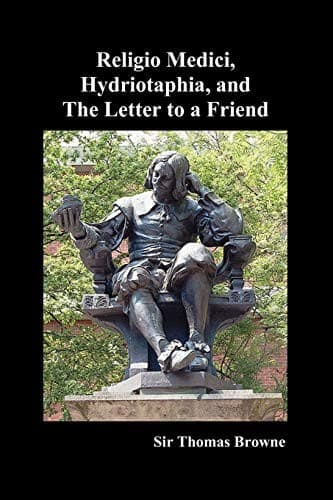
Religio Medici, Hydriotaphia, and the Letter to a FriendBrowne, Thomas, Sir
Religion
Religio Medici, Hydriotaphia, and the Letter to a Friend
Browne, Thomas, Sir
Christian ethics; Christian life; Essays; Funeral rites and ceremonies; Medical ethics; Medicine -- History; Religion and medicine
Circles and right lines limit and close all bodies, and the mortal
right-lined circle[BV] must conclude and shut up all. There is no
antidote against the opium of time, which temporally considereth all
things: our fathers find their graves in our short memories, and sadly
tell us how we may be buried in our survivors. Gravestones tell truth
scarce forty years. Generations pass while some trees stand, and old
families last not three oaks. To be read by bare inscriptions like
many in Gruter, to hope for eternity by enigmatical epithets or first
letters of our names, to be studied by antiquaries, who we were, and
have new names given us like many of the mummies, are cold consolations
unto the students of perpetuity, even by everlasting languages.
[BV] The character of death.
To be content that times to come should only know there was such a
man, not caring whether they knew more of him, was a frigid ambition
in Cardan;[BW] disparaging his horoscopal inclination and judgment
of himself. Who cares to subsist like Hippocrates’s patients, or
Achilles’s horses in Homer, under naked nominations, without deserts
and noble acts, which are the balsam of our memories, the _entelechia_
and soul of our subsistences? To be nameless in worthy deeds, exceeds
an infamous history. The Canaanitish woman lives more happily without a
name, than Herodias with one. And who had not rather have been the good
thief, than Pilate?
[BW] “Cuperem notum esse quod sim non opto ut sciatur qualis sim.”
But the iniquity of oblivion blindly scattereth her poppy, and deals
with the memory of men without distinction to merit of perpetuity.
Who can but pity the founder of the pyramids? Herostratus lives that
burnt the temple of Diana, he is almost lost that built it. Time hath
spared the epitaph of Adrian’s horse, confounded that of himself. In
vain we compute our felicities by the advantage of our good names,
since bad have equal durations, and Thersites is like to live as long
as Agamemnon without the favour of the everlasting register. Who
knows whether the best of men be known, or whether there be not more
remarkable persons forgot, than any that stand remembered in the known
account of time? The first man had been as unknown as the last, and
Methuselah’s long life had been his only chronicle.
Public-domain text, read in full here on John Shaqi.
Reviews
Reviews
No reviews yet
Be the first to share your thoughts on this work.
Elsewhere in the archive
Join the Discussion
Join the discussion
Sign in to leave a comment or review.
Sign InorCreate an account