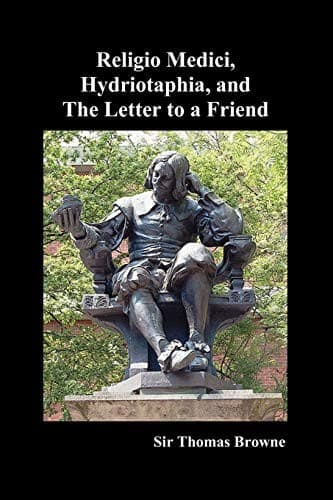
Religio Medici, Hydriotaphia, and the Letter to a FriendBrowne, Thomas, Sir
Religion
Religio Medici, Hydriotaphia, and the Letter to a Friend
Browne, Thomas, Sir
Christian ethics; Christian life; Essays; Funeral rites and ceremonies; Medical ethics; Medicine -- History; Religion and medicine
Oblivion is not to be hired. The greater part must be content to be as
though they had not been, to be found in the register of God, not in
the record of man. Twenty-seven names make up the first story and the
recorded names ever since contain not one living century. The number
of the dead long exceedeth all that shall live. The night of time far
surpasseth the day, and who knows when was the equinox? Every hour
adds unto that current arithmetick, which scarce stands one moment.
And since death must be the _Lucina_ of life, and even Pagans[108]
could doubt, whether thus to live were to die; since our longest sun
sets at right descensions, and makes but winter arches, and therefore
it cannot be long before we lie down in darkness, and have our light
in ashes; since the brother of death daily haunts us with dying
mementoes, and time that grows old in itself, bids us hope no long
duration;--diuturnity is a dream and folly of expectation.
Darkness and light divide the course of time, and oblivion shares
with memory a great part even of our living beings; we slightly
remember our felicities, and the smartest strokes of affliction leave
but short smart upon us. Sense endureth no extremities, and sorrows
destroy us or themselves. To weep into stones are fables. Afflictions
induce callosities; miseries are slippery, or fall like snow upon
us, which notwithstanding is no unhappy stupidity. To be ignorant of
evils to come, and forgetful of evils past, is a merciful provision
in nature, whereby we digest the mixture of our few and evil days,
and, our delivered senses not relapsing into cutting remembrances, our
sorrows are not kept raw by the edge of repetitions. A great part of
antiquity contented their hopes of subsistency with a transmigration
of their souls,--a good way to continue their memories, while having
the advantage of plural successions, they could not but act something
remarkable in such variety of beings, and enjoying the fame of their
passed selves, make accumulation of glory unto their last durations.
Others, rather than be lost in the uncomfortable night of nothing,
were content to recede into the common being, and make one particle of
the public soul of all things, which was no more than to return into
their unknown and divine original again. Egyptian ingenuity was more
unsatisfied, contriving their bodies in sweet consistences, to attend
the return of their souls. But all is vanity, feeding the wind, and
folly. Egyptian mummies, which Cambyses or time hath spared, avarice
now consumeth. Mummy is become merchandise, Mizraim, cures wounds, and
Pharaoh is sold for balsams.
Public-domain text, read in full here on John Shaqi.
Reviews
Reviews
No reviews yet
Be the first to share your thoughts on this work.
Elsewhere in the archive
Join the Discussion
Join the discussion
Sign in to leave a comment or review.
Sign InorCreate an account