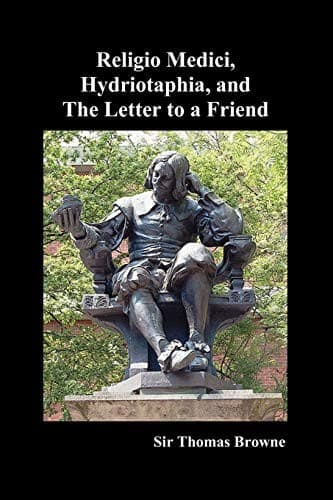
Religio Medici, Hydriotaphia, and the Letter to a FriendBrowne, Thomas, Sir
Religion
Religio Medici, Hydriotaphia, and the Letter to a Friend
Browne, Thomas, Sir
Christian ethics; Christian life; Essays; Funeral rites and ceremonies; Medical ethics; Medicine -- History; Religion and medicine
_Sect._ 9.--As for those wingy mysteries in divinity, and airy
subtleties in religion, which have unhinged the brains of better
heads, they never stretched the _pia mater_[11] of mine. Methinks
there be not impossibilities enough in religion for an active faith:
the deepest mysteries ours contains have not only been illustrated,
but maintained, by syllogism and the rule of reason. I love to lose
myself in a mystery; to pursue my reason to an _O altitudo!_ ’Tis my
solitary recreation to pose my apprehension with those involved enigmas
and riddles of the Trinity--with incarnation and resurrection. I can
answer all the objections of Satan and my rebellious reason with that
odd resolution I learned of Tertullian, “_Certum est quia impossibile
est_.” I desire to exercise my faith in the difficultest point; for, to
credit ordinary and visible objects, is not faith, but persuasion. Some
believe the better for seeing Christ’s sepulchre; and, when they have
seen the Red Sea, doubt not of the miracle. Now, contrarily, I bless
myself, and am thankful, that I lived not in the days of miracles; that
I never saw Christ nor his disciples. I would not have been one of
those Israelites that passed the Red Sea; nor one of Christ’s patients,
on whom he wrought his wonders: then had my faith been thrust upon me;
nor should I enjoy that greater blessing pronounced to all that believe
and saw not. ’Tis an easy and necessary belief, to credit what our eye
and sense hath examined. I believe he was dead, and buried, and rose
again; and desire to see him in his glory, rather than to contemplate
him in his cenotaph or sepulchre. Nor is this much to believe; as
we have reason, we owe this faith unto history: they only had the
advantage of a bold and noble faith, who lived before his coming, who,
upon obscure prophesies and mystical types, could raise a belief, and
expect apparent impossibilities.
Public-domain text, read in full here on John Shaqi.
Reviews
Reviews
No reviews yet
Be the first to share your thoughts on this work.
Join the Discussion
Join the discussion
Sign in to leave a comment or review.
Sign InorCreate an account