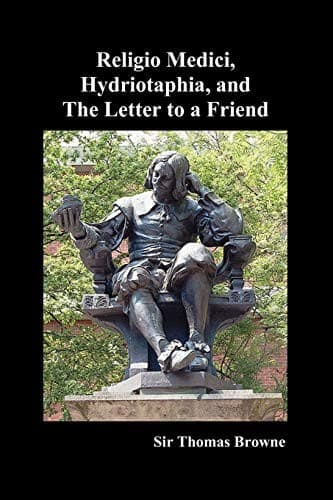
Religio Medici, Hydriotaphia, and the Letter to a FriendBrowne, Thomas, Sir
Religion
Religio Medici, Hydriotaphia, and the Letter to a Friend
Browne, Thomas, Sir
Christian ethics; Christian life; Essays; Funeral rites and ceremonies; Medical ethics; Medicine -- History; Religion and medicine
_Sect._ 11.--In my solitary and retired imagination (“_neque enim cum
porticus aut me lectulus accepit, desum mihi_”), I remember I am not
alone; and therefore forget not to contemplate him and his attributes,
who is ever with me, especially those two mighty ones, his wisdom
and eternity. With the one I recreate, with the other I confound, my
understanding: for who can speak of eternity without a solecism, or
think thereof without an ecstasy? Time we may comprehend; ’tis but five
days elder than ourselves, and hath the same horoscope with the world;
but, to retire so far back as to apprehend a beginning,--to give such
an infinite start forwards as to conceive an end,--in an essence that
we affirm hath neither the one nor the other, it puts my reason to St
Paul’s sanctuary: my philosophy dares not say the angels can do it.
God hath not made a creature that can comprehend him; ’tis a privilege
of his own nature: “I am that I am” was his own definition unto Moses;
and ’twas a short one to confound mortality, that durst question God,
or ask him what he was. Indeed, he only is; all others have and shall
be; but, in eternity, there is no distinction of tenses; and therefore
that terrible term, predestination, which hath troubled so many weak
heads to conceive, and the wisest to explain, is in respect to God no
prescious determination of our estates to come, but a definitive blast
of his will already fulfilled, and at the instant that he first decreed
it; for, to his eternity, which is indivisible, and altogether, the
last trump is already sounded, the reprobates in the flame, and the
blessed in Abraham’s bosom. St Peter speaks modestly, when he saith,
“a thousand years to God are but as one day;” for, to speak like a
philosopher, those continued instances of time, which flow into a
thousand years, make not to him one moment. What to us is to come, to
his eternity is present; his whole duration being but one permanent
point, without succession, parts, flux, or division.
Public-domain text, read in full here on John Shaqi.
Reviews
Reviews
No reviews yet
Be the first to share your thoughts on this work.
Join the Discussion
Join the discussion
Sign in to leave a comment or review.
Sign InorCreate an account