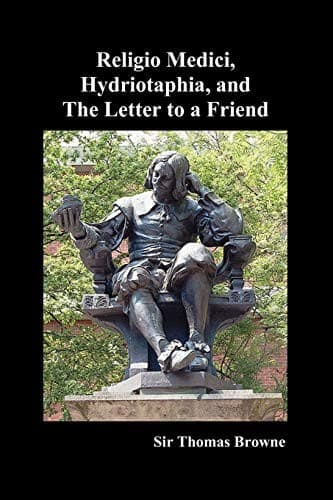
Religio Medici, Hydriotaphia, and the Letter to a FriendBrowne, Thomas, Sir
Religion
Religio Medici, Hydriotaphia, and the Letter to a Friend
Browne, Thomas, Sir
Christian ethics; Christian life; Essays; Funeral rites and ceremonies; Medical ethics; Medicine -- History; Religion and medicine
Seignior proudly said, if they should trouble him, as they did the
Spaniard, he would send his men with shovels and pickaxes, and throw it
into the sea) I cannot altogether ascribe to the ingenuity and industry
of the people, but the mercy of God, that hath disposed them to such a
thriving genius; and to the will of his providence, that disposeth her
favour to each country in their preordinate season. All cannot be happy
at once; for, because the glory of one state depends upon the ruin of
another, there is a revolution and vicissitude of their greatness, and
must obey the swing of that wheel, not moved by intelligencies, but by
the hand of God, whereby all estates arise to their zenith and vertical
points, according to their predestinated periods. For the lives, not
only of men, but of commonwealths and the whole world, run not upon a
helix that still enlargeth; but on a circle, where, arriving to their
meridian, they decline in obscurity, and fall under the horizon again.
_Sect._ 18.--These must not therefore be named the effects of fortune
but in a relative way, and as we term the works of nature. It was
the ignorance of man’s reason that begat this very name, and by a
careless term miscalled the providence of God: for there is no liberty
for causes to operate in a loose and straggling way; nor any effect
whatsoever but hath its warrant from some universal or superior cause.
’Tis not a ridiculous devotion to say a prayer before a game at tables;
for, even in sortileges[21] and matters of greatest uncertainty,
there is a settled and preordered course of effects. It is we that
are blind, not fortune. Because our eye is too dim to discover the
mystery of her effects, we foolishly paint her blind, and hoodwink the
providence of the Almighty. I cannot justify that contemptible proverb,
that “fools only are fortunate;” or that insolent paradox, that “a
wise man is out of the reach of fortune;” much less those opprobrious
epithets of poets,--“whore,” “bawd,” and “strumpet.” ’Tis, I confess,
the common fate of men of singular gifts of mind, to be destitute of
those of fortune; which doth not any way deject the spirit of wiser
judgments who thoroughly understand the justice of this proceeding;
and, being enriched with higher donatives, cast a more careless eye
on these vulgar parts of felicity. It is a most unjust ambition, to
desire to engross the mercies of the Almighty, not to be content with
the goods of mind, without a possession of those of body or fortune:
and it is an error, worse than heresy, to adore these complimental and
circumstantial pieces of felicity, and undervalue those perfections
and essential points of happiness, wherein we resemble our Maker.
To wiser desires it is satisfaction enough to deserve, though not
to enjoy, the favours of fortune. Let providence provide for fools:
’tis not partiality, but equity, in God, who deals with us but as our
natural parents. Those that are able of body and mind he leaves to
Public-domain text, read in full here on John Shaqi.
Reviews
Reviews
No reviews yet
Be the first to share your thoughts on this work.
Join the Discussion
Join the discussion
Sign in to leave a comment or review.
Sign InorCreate an account