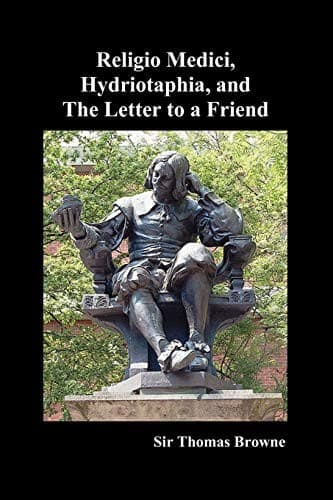
Religio Medici, Hydriotaphia, and the Letter to a FriendBrowne, Thomas, Sir
Religion
Religio Medici, Hydriotaphia, and the Letter to a Friend
Browne, Thomas, Sir
Christian ethics; Christian life; Essays; Funeral rites and ceremonies; Medical ethics; Medicine -- History; Religion and medicine
_Sect._ 24.--I have heard some with deep sighs lament the lost lines
of Cicero; others with as many groans deplore the combustion of the
library of Alexandria;[33] for my own part, I think there be too many
in the world; and could with patience behold the urn and ashes of the
Vatican, could I, with a few others, recover the perished leaves of
Solomon. I would not omit a copy of Enoch’s pillars,[34] had they many
nearer authors than Josephus, or did not relish somewhat of the fable.
Some men have written more than others have spoken. Pineda[35] quotes
more authors, in one work,[G] than are necessary in a whole world.
Of those three great inventions in Germany,[36] there are two which
are not without their incommodities, and ’tis disputable whether they
exceed not their use and commodities. ’Tis not a melancholy _utinam_
of my own, but the desires of better heads, that there were a general
synod--not to unite the incompatible difference of religion, but,--for
the benefit of learning, to reduce it, as it lay at first, in a few and
solid authors; and to condemn to the fire those swarms and millions of
rhapsodies, begotten only to distract and abuse the weaker judgments of
scholars, and to maintain the trade and mystery of typographers.
[G] Pineda, in his “Monarchia Ecclesiastica,” quotes one thousand and
forty authors.
_Sect._ 25.--I cannot but wonder with what exception the Samaritans
could confine their belief to the Pentateuch, or five books of Moses.
I am ashamed at the rabbinical interpretation of the Jews upon the
Old Testament,[37] as much as their defection from the New: and truly
it is beyond wonder, how that contemptible and degenerate issue
of Jacob, once so devoted to ethnick superstition, and so easily
seduced to the idolatry of their neighbours, should now, in such an
obstinate and peremptory belief, adhere unto their own doctrine, expect
impossibilities, and in the face and eye of the church, persist without
the least hope of conversion. This is a vice in them, that were a
virtue in us; for obstinacy in a bad cause is but constancy in a good:
and herein I must accuse those of my own religion; for there is not
any of such a fugitive faith, such an unstable belief, as a Christian;
none that do so often transform themselves, not unto several shapes
of Christianity, and of the same species, but unto more unnatural and
contrary forms of Jew and Mohammedan; that, from the name of Saviour,
can condescend to the bare term of prophet: and, from an old belief
that he is come, fall to a new expectation of his coming. It is the
promise of Christ, to make us all one flock: but how and when this
union shall be, is as obscure to me as the last day. Of those four
members of religion we hold a slender proportion.[38] There are, I
confess, some new additions; yet small to those which accrue to our
adversaries; and those only drawn from the revolt of pagans; men but
of negative impieties; and such as deny Christ, but because they never
heard of him.
Public-domain text, read in full here on John Shaqi.
Reviews
Reviews
No reviews yet
Be the first to share your thoughts on this work.
Join the Discussion
Join the discussion
Sign in to leave a comment or review.
Sign InorCreate an account