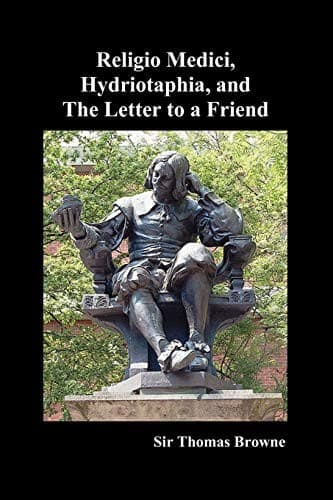
Religio Medici, Hydriotaphia, and the Letter to a FriendBrowne, Thomas, Sir
Religion
Religio Medici, Hydriotaphia, and the Letter to a Friend
Browne, Thomas, Sir
Christian ethics; Christian life; Essays; Funeral rites and ceremonies; Medical ethics; Medicine -- History; Religion and medicine
or somebody from him; for so the original signifies; and is as likely
to be the doubtful family’s meaning. This exposition I once suggested
to a young divine, that answered upon this point; to which I remember
the Franciscan opponent replied no more, but, that it was a new, and no
authentick interpretation.
_Sect._ 23.--These are but the conclusions and fallible discourses of
man upon the word of God; for such I do believe the Holy Scriptures;
yet, were it of man, I could not choose but say, it was the singularest
and superlative piece that hath been extant since the creation. Were
I a pagan, I should not refrain the lecture of it; and cannot but
commend the judgment of Ptolemy, that thought not his library complete
without it. The Alcoran of the Turks (I speak without prejudice)
is an ill-composed piece, containing in it vain and ridiculous
errors in philosophy, impossibilities, fictions, and vanities beyond
laughter, maintained by evident and open sophisms, the policy of
ignorance, deposition of universities, and banishment of learning.
That hath gotten foot by arms and violence: this, without a blow, hath
disseminated itself through the whole earth. It is not unremarkable,
what Philo first observed, that the law of Moses continued two thousand
years without the least alteration; whereas, we see, the laws of other
commonwealths do alter with occasions: and even those, that pretended
their original from some divinity, to have vanished without trace or
memory. I believe, besides Zoroaster, there were divers others that
writ before Moses; who, notwithstanding, have suffered the common
fate of time. Men’s works have an age, like themselves; and though
they outlive their authors, yet have they a stint and period to their
duration. This only is a work too hard for the teeth of time, and
cannot perish but in the general flames, when all things shall confess
their ashes.
Public-domain text, read in full here on John Shaqi.
Reviews
Reviews
No reviews yet
Be the first to share your thoughts on this work.
Join the Discussion
Join the discussion
Sign in to leave a comment or review.
Sign InorCreate an account