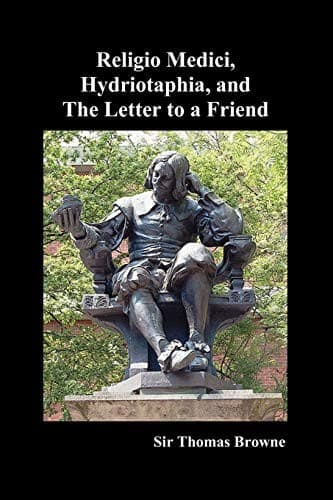
Religio Medici, Hydriotaphia, and the Letter to a FriendBrowne, Thomas, Sir
Religion
Religio Medici, Hydriotaphia, and the Letter to a Friend
Browne, Thomas, Sir
Christian ethics; Christian life; Essays; Funeral rites and ceremonies; Medical ethics; Medicine -- History; Religion and medicine
_Sect._ 33.--Therefore, for spirits, I am so far from denying their
existence, that I could easily believe, that not only whole countries,
but particular persons, have their tutelary and guardian angels. It is
not a new opinion of the Church of Rome, but an old one of Pythagoras
and Plato: there is no heresy in it: and if not manifestly defined in
Scripture, yet it is an opinion of a good and wholesome use in the
course and actions of a man’s life; and would serve as an hypothesis
to salve many doubts, whereof common philosophy affordeth no solution.
Now, if you demand my opinion and metaphysicks of their natures, I
confess them very shallow; most of them in a negative way, like that
of God; or in a comparative, between ourselves and fellow-creatures:
for there is in this universe a stair, or manifest scale, of creatures,
rising not disorderly, or in confusion, but with a comely method and
proportion. Between creatures of mere existence and things of life
there is a large disproportion of nature: between plants and animals,
or creatures of sense, a wider difference: between them and man, a
far greater: and if the proportion hold on, between man and angels
there should be yet a greater. We do not comprehend their natures,
who retain the first definition of Porphyry;[48] and distinguish them
from ourselves by immortality: for, before his fall, man also was
immortal: yet must we needs affirm that he had a different essence
from the angels. Having, therefore, no certain knowledge of their
nature, ’tis no bad method of the schools, whatsoever perfection we
find obscurely in ourselves, in a more complete and absolute way to
ascribe unto them. I believe they have an extemporary knowledge, and,
upon the first motion of their reason, do what we cannot without study
or deliberation: that they know things by their forms, and define, by
specifical difference what we describe by accidents and properties: and
therefore probabilities to us may be demonstrations unto them: that
they have knowledge not only of the specifical, but numerical, forms
of individuals, and understand by what reserved difference each single
hypostatis (besides the relation to its species) becomes its numerical
self: that, as the soul hath a power to move the body it informs, so
there’s a faculty to move any, though inform none: ours upon restraint
of time, place, and distance: but that invisible hand that conveyed
Habakkuk to the lion’s den, or Philip to Azotus, infringeth this rule,
and hath a secret conveyance, wherewith mortality is not acquainted.
If they have that intuitive knowledge, whereby, as in reflection, they
behold the thoughts of one another, I cannot peremptorily deny but
they know a great part of ours. They that, to refute the invocation
of saints, have denied that they have any knowledge of our affairs
below, have proceeded too far, and must pardon my opinion, till I can
thoroughly answer that piece of Scripture, “At the conversion of a
Public-domain text, read in full here on John Shaqi.
Reviews
Reviews
No reviews yet
Be the first to share your thoughts on this work.
Join the Discussion
Join the discussion
Sign in to leave a comment or review.
Sign InorCreate an account