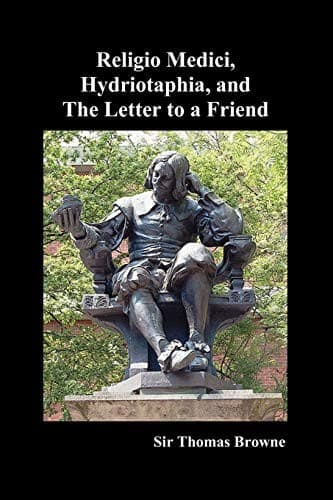
Religio Medici, Hydriotaphia, and the Letter to a FriendBrowne, Thomas, Sir
Religion
Religio Medici, Hydriotaphia, and the Letter to a Friend
Browne, Thomas, Sir
Christian ethics; Christian life; Essays; Funeral rites and ceremonies; Medical ethics; Medicine -- History; Religion and medicine
sinner, the angels in heaven rejoice.” I cannot, with those in that
great father,[49] securely interpret the work of the first day, _fiat
lux_, to the creation of angels; though I confess there is not any
creature that hath so near a glimpse of their nature as light in the
sun and elements: we style it a bare accident; but, where it subsists
alone, ’tis a spiritual substance, and may be an angel: in brief,
conceive light invisible, and that is a spirit.
_Sect._ 34.--These are certainly the magisterial and masterpieces of
the Creator; the flower, or, as we may say, the best part of nothing;
actually existing, what we are but in hopes, and probability. We
are only that amphibious piece, between a corporeal and a spiritual
essence; that middle form, that links those two together, and makes
good the method of God and nature, that jumps not from extremes, but
unites the incompatible distances by some middle and participating
natures. That we are the breath and similitude of God, it is
indisputable, and upon record of Holy Scripture: but to call ourselves
a microcosm, or little world, I thought it only a pleasant trope of
rhetorick, till my near judgment and second thoughts told me there was
a real truth therein. For, first we are a rude mass, and in the rank
of creatures which only are, and have a dull kind of being, not yet
privileged with life, or preferred to sense or reason; next we live the
life of plants, the life of animals, the life of men, and at last the
life of spirits: running on, in one mysterious nature, those five kinds
of existencies, which comprehend the creatures, not only of the world,
but of the universe. Thus is man that great and true _amphibium_, whose
nature is disposed to live, not only like other creatures in divers
elements, but in divided and distinguished worlds; for though there be
but one to sense, there are two to reason, the one visible, the other
invisible; whereof Moses seems to have left description, and of the
other so obscurely, that some parts thereof are yet in controversy.
And truly, for the first chapters of Genesis, I must confess a great
deal of obscurity; though divines have, to the power of human reason,
endeavoured to make all go in a literal meaning, yet those allegorical
interpretations are also probable, and perhaps the mystical method of
Moses, bred up in the hieroglyphical schools of the Egyptians.
Public-domain text, read in full here on John Shaqi.
Reviews
Reviews
No reviews yet
Be the first to share your thoughts on this work.
Join the Discussion
Join the discussion
Sign in to leave a comment or review.
Sign InorCreate an account