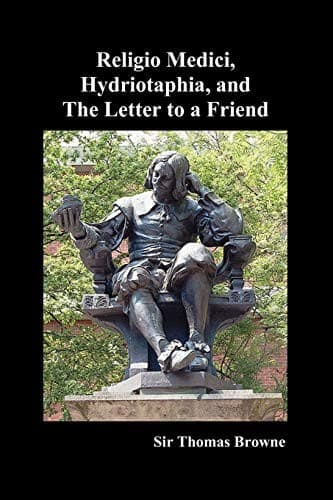
Religio Medici, Hydriotaphia, and the Letter to a FriendBrowne, Thomas, Sir
Religion
Religio Medici, Hydriotaphia, and the Letter to a Friend
Browne, Thomas, Sir
Christian ethics; Christian life; Essays; Funeral rites and ceremonies; Medical ethics; Medicine -- History; Religion and medicine
_Sect._ 36.--The whole creation is a mystery, and particularly that of
man. At the blast of his mouth were the rest of the creatures made;
and at his bare word they started out of nothing: but in the frame of
man (as the text describes it) he played the sensible operator, and
seemed not so much to create as make him. When he had separated the
materials of other creatures, there consequently resulted a form and
soul; but, having raised the walls of man, he was driven to a second
and harder creation,--of a substance like himself, an incorruptible
and immortal soul. For these two affections we have the philosophy
and opinion of the heathens, the flat affirmative of Plato, and not a
negative from Aristotle. There is another scruple cast in by divinity
concerning its production, much disputed in the German auditories,
and with that indifferency and equality of arguments, as leave the
controversy undetermined. I am not of Paracelsus’s mind, that boldly
delivers a receipt to make a man without conjunction; yet cannot but
wonder at the multitude of heads that do deny traduction, having no
other arguments to confirm their belief than that rhetorical sentence
and _antimetathesis_[51] of Augustine, “_creando infunditur, infundendo
creatur_.” Either opinion will consist well enough with religion: yet
I should rather incline to this, did not one objection haunt me, not
wrung from speculations and subtleties, but from common sense and
observation; not pick’d from the leaves of any author, but bred amongst
the weeds and tares of my own brain. And this is a conclusion from the
equivocal and monstrous productions in the copulation of a man with a
beast: for if the soul of man be not transmitted and transfused in the
seed of the parents, why are not those productions merely beasts, but
have also an impression and tincture of reason in as high a measure,
as it can evidence itself in those improper organs? Nor, truly, can
I peremptorily deny that the soul, in this her sublunary estate,
is wholly, and in all acceptions, inorganical: but that, for the
performance of her ordinary actions, is required not only a symmetry
and proper disposition of organs, but a crasis and temper correspondent
to its operations; yet is not this mass of flesh and visible structure
the instrument and proper corpse of the soul, but rather of sense,
and that the hand of reason. In our study of anatomy there is a mass
of mysterious philosophy, and such as reduced the very heathens to
divinity; yet, amongst all those rare discoveries and curious pieces I
find in the fabrick of man, I do not so much content myself, as in that
I find not,--that is, no organ or instrument for the rational soul; for
in the brain, which we term the seat of reason, there is not anything
of moment more than I can discover in the crany of a beast; and this
is a sensible and no inconsiderable argument of the inorganity of the
soul, at least in that sense we usually so conceive it. Thus we are
Public-domain text, read in full here on John Shaqi.
Reviews
Reviews
No reviews yet
Be the first to share your thoughts on this work.
Join the Discussion
Join the discussion
Sign in to leave a comment or review.
Sign InorCreate an account