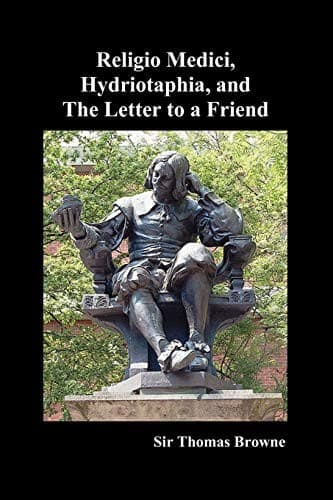
Religio Medici, Hydriotaphia, and the Letter to a FriendBrowne, Thomas, Sir
Religion
Religio Medici, Hydriotaphia, and the Letter to a Friend
Browne, Thomas, Sir
Christian ethics; Christian life; Essays; Funeral rites and ceremonies; Medical ethics; Medicine -- History; Religion and medicine
_Sect._ 35.--Now for that immaterial world, methinks we need not wander
so far as the first moveable; for, even in this material fabrick, the
spirits walk as freely exempt from the affection of time, place, and
motion, as beyond the extremest circumference. Do but extract from the
corpulency of bodies, or resolve things beyond their first matter, and
you discover the habitation of angels; which if I call the ubiquitary
and omnipresent essence of God, I hope I shall not offend divinity:
for, before the creation of the world, God was really all things.
For the angels he created no new world, or determinate mansion, and
therefore they are everywhere where is his essence, and do live, at a
distance even, in himself. That God made all things for man, is in some
sense true; yet, not so far as to subordinate the creation of those
purer creatures unto ours; though, as ministering spirits, they do,
and are willing to fulfil the will of God in these lower and sublunary
affairs of man. God made all things for himself; and it is impossible
he should make them for any other end than his own glory: it is all
he can receive, and all that is without himself. For, honour being
an external adjunct, and in the honourer rather than in the person
honoured, it was necessary to make a creature, from whom he might
receive this homage: and that is, in the other world, angels, in this,
man; which when we neglect, we forget God, not only to repent that
he hath made the world, but that he hath sworn he would not destroy
it. That there is but one world, is a conclusion of faith; Aristotle
with all his philosophy hath not been able to prove it: and as weakly
that the world was eternal; that dispute much troubled the pen of the
philosophers, but Moses decided that question, and all is salved with
the new term of a creation,--that is, a production of something out of
nothing. And what is that?--whatsoever is opposite to something; or,
more exactly, that which is truly contrary unto God: for he only is;
all others have an existence with dependency, and are something but by
a distinction. And herein is divinity conformant unto philosophy, and
generation not only founded on contrarieties, but also creation. God,
being all things, is contrary unto nothing; out of which were made
all things, and so nothing became something, and omneity[50] informed
nullity into an essence.
Public-domain text, read in full here on John Shaqi.
Reviews
Reviews
No reviews yet
Be the first to share your thoughts on this work.
Join the Discussion
Join the discussion
Sign in to leave a comment or review.
Sign InorCreate an account