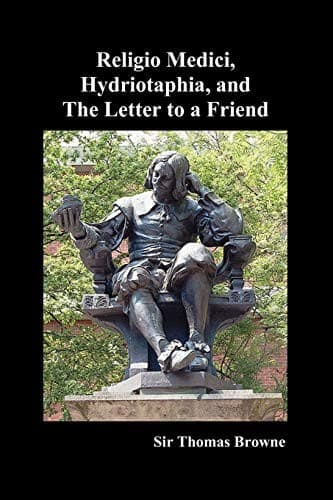
Religio Medici, Hydriotaphia, and the Letter to a FriendBrowne, Thomas, Sir
Religion
Religio Medici, Hydriotaphia, and the Letter to a Friend
Browne, Thomas, Sir
Christian ethics; Christian life; Essays; Funeral rites and ceremonies; Medical ethics; Medicine -- History; Religion and medicine
The text of the present edition of the “Religio Medici” is taken from
what is called the eighth edition, but is in reality the eleventh,
published in London in 1682, the last edition in the author’s lifetime.
The notes are for the most part compiled from the observations of Sir
Kenelm Digby, the annotation of Mr. Keck, and the very valuable notes
of Simon Wilkin. For the account of the finding of Sir Thomas Browne’s
skull I am indebted to Mr Friswell’s notice of Sir Thomas in his
“Varia.” The text of the “Hydriotaphia” is taken from the folio edition
of 1686, in the Lincoln’s Inn library. Some of Browne’s notes to that
edition have been omitted, and most of the references, as they refer to
books which are not likely to be met with by the general reader.
The “Letter to a Friend, upon the occasion of the Death of his intimate
Friend,” was first published in a folio pamphlet in 1690. It was
reprinted in his posthumous works. The concluding reflexions are the
basis of a larger work, “Christian Morals.” I am not aware of any
complete modern edition of it. The text of the present one is taken
from the original edition of 1690. The pamphlet is in the British
Museum, bound up with a volume of old poems. It is entitled, “A Letter
to a Friend, upon the occasion of the Death of his intimate Friend.
By the learned Sir Thomas Brown, Knight, Doctor of Physick, late of
Norwich. London: Printed for Charles Brone, at the Gun, at the West End
of St Paul’s Churchyard, 1690.”
TO THE READER.
CERTAINLY that man were greedy of life, who should desire to live when
all the world were at an end; and he must needs be very impatient,
who would repine at death in the society of all things that suffer
under it. Had not almost every man suffered by the press, or were not
the tyranny thereof become universal, I had not wanted reason for
complaint: but in times wherein I have lived to behold the highest
perversion of that excellent invention, the name of his Majesty
defamed, the honour of Parliament depraved, the writings of both
depravedly, anticipatively, counterfeitly, imprinted: complaints may
seem ridiculous in private persons; and men of my condition may be as
incapable of affronts, as hopeless of their reparations. And truly had
not the duty I owe unto the importunity of friends, and the allegiance
I must ever acknowledge unto truth, prevailed with me; the inactivity
of my disposition might have made these sufferings continual, and
time, that brings other things to light, should have satisfied me in
the remedy of its oblivion. But because things evidently false are
not only printed, but many things of truth most falsely set forth;
in this latter I could not but think myself engaged: for, though we
have no power to redress the former, yet in the other reparation being
within ourselves, I have at present represented unto the world a
full and intended copy of that piece, which was most imperfectly and
surreptitiously published before.
Public-domain text, read in full here on John Shaqi.
Reviews
Reviews
No reviews yet
Be the first to share your thoughts on this work.
Join the Discussion
Join the discussion
Sign in to leave a comment or review.
Sign InorCreate an account