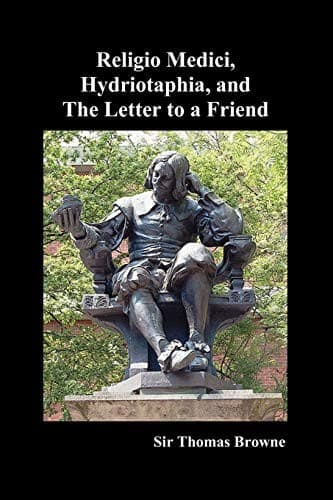
Religio Medici, Hydriotaphia, and the Letter to a FriendBrowne, Thomas, Sir
Religion
Religio Medici, Hydriotaphia, and the Letter to a Friend
Browne, Thomas, Sir
Christian ethics; Christian life; Essays; Funeral rites and ceremonies; Medical ethics; Medicine -- History; Religion and medicine
It is upon his “Religio Medici”--the religion of a physician--that
Browne’s fame chiefly rests. It was his first and most celebrated work,
published just after his return from his travels; it gives us the
impressions made on his mind by the various and opposite schools he had
passed through. He tells us that he never intended to publish it, but
that on its being surreptitiously printed, he was induced to do so. In
1643, the first genuine edition appeared, with “an admonition to such
as shall peruse the observations upon a former corrupt copy of this
book.” The observations here alluded to, were written by Sir Kenelm
Digby, and sent by him to the Earl of Dorset. They were first printed
at the end of the edition of 1643, and have ever since been published
with the book. Their chief merit consists in the marvellous rapidity
with which they were written, Sir Kenelm having, as he tells us, bought
the book, read it, and written his observations, in the course of
twenty-four hours!
The book contains what may be termed an apology for his belief. He
states the reasons on which he grounds his opinions, and endeavours
to show that, although he had been accused of atheism, he was in all
points a good Christian, and a loyal member of the Church of England.
Each person must judge for himself of his success; but the effect it
produced on the mind of Johnson may be noticed. “The opinions of every
man,” says he, “must be learned from himself; concerning his practice,
it is safer to trust to the evidence of others. When the testimonies
concur, no higher degree of historical certainty can be obtained; and
they apparently concur to prove that Browne was a zealous adherent to
the faith of Christ, that he lived in obedience to His laws, and died
in confidence of His mercy.”
The best proof of the excellence of the “Religio” is to be found in
its great success. During the author’s life, from 1643 to 1681, it
passed through eleven editions. It has been translated into Latin,
Dutch, French, and German, and many of the translations have passed
through several editions. No less than thirty-three treatises have been
written in imitation of it; and what, to some, will be the greatest
proof of all, it was soon after its publication placed in the Index
Expurgatorius. The best proof of its liberality of sentiment is in the
fact that its author was claimed at the same time by the Romanists and
Quakers to be a member of their respective creeds!
The “Hydriotaphia,” or Urn-burial, is a treatise on the funeral rites
of ancient nations. It was caused by the discovery of some Roman urns
in Norfolk. Though inferior to the “Religio,” “there is perhaps none of
his works which better exemplifies his reading or memory.”
Public-domain text, read in full here on John Shaqi.
Reviews
Reviews
No reviews yet
Be the first to share your thoughts on this work.
Join the Discussion
Join the discussion
Sign in to leave a comment or review.
Sign InorCreate an account