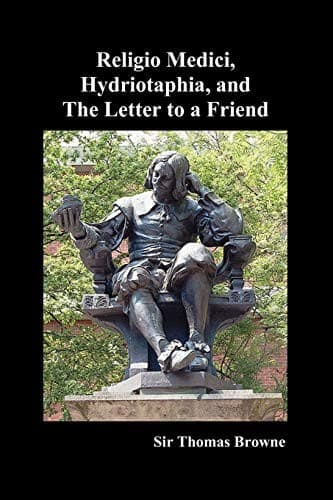
Religio Medici, Hydriotaphia, and the Letter to a FriendBrowne, Thomas, Sir
Religion
Religio Medici, Hydriotaphia, and the Letter to a Friend
Browne, Thomas, Sir
Christian ethics; Christian life; Essays; Funeral rites and ceremonies; Medical ethics; Medicine -- History; Religion and medicine
to repentance: there goes indignation, anger, sorrow, hatred, into
mine, passions of a contrary nature, which neither seem to suit with
this action, nor my proper constitution. It is no breach of charity to
ourselves to be at variance with our vices, nor to abhor that part of
us, which is an enemy to the ground of charity, our God; wherein we
do but imitate our great selves, the world, whose divided antipathies
and contrary faces do yet carry a charitable regard unto the whole, by
their particular discords preserving the common harmony, and keeping in
fetters those powers, whose rebellions, once masters, might be the ruin
of all.
_Sect._ 8.--I thank God, amongst those millions of vices I do inherit
and hold from Adam, I have escaped one, and that a mortal enemy to
charity,--the first and father sin, not only of man, but of the
devil,--pride; a vice whose name is comprehended in a monosyllable,
but in its nature not circumscribed with a world, I have escaped it
in a condition that can hardly avoid it. Those petty acquisitions and
reputed perfections, that advance and elevate the conceits of other
men, add no feathers unto mine. I have seen a grammarian tower and
plume himself over a single line in Horace, and show more pride, in
the construction of one ode, than the author in the composure of the
whole book. For my own part, besides the jargon and _patois_ of several
provinces, I understand no less than six languages; yet I protest
I have no higher conceit of myself than had our fathers before the
confusion of Babel, when there was but one language in the world, and
none to boast himself either linguist or critick. I have not only seen
several countries, beheld the nature of their climes, the chorography
of their provinces, topography of their cities, but understood their
several laws, customs, and policies; yet cannot all this persuade the
dulness of my spirit unto such an opinion of myself as I behold in
nimbler and conceited heads, that never looked a degree beyond their
nests. I know the names and somewhat more of all the constellations in
my horizon; yet I have seen a prating mariner, that could only name
the pointers and the north-star, out-talk me, and conceit himself
a whole sphere above me. I know most of the plants of my country,
and of those about me, yet methinks I do not know so many as when I
did but know a hundred, and had scarcely ever simpled further than
Cheapside. For, indeed, heads of capacity, and such as are not full
with a handful or easy measure of knowledge, think they know nothing
till they know all; which being impossible, they fall upon the opinion
of Socrates, and only know they know not anything. I cannot think that
Homer pined away upon the riddle of the fishermen, or that Aristotle,
who understood the uncertainty of knowledge, and confessed so often
the reason of man too weak for the works of nature, did ever drown
himself upon the flux and reflux of Euripus.[93] We do but learn,
Public-domain text, read in full here on John Shaqi.
Reviews
Reviews
No reviews yet
Be the first to share your thoughts on this work.
Elsewhere in the archive
Join the Discussion
Join the discussion
Sign in to leave a comment or review.
Sign InorCreate an account