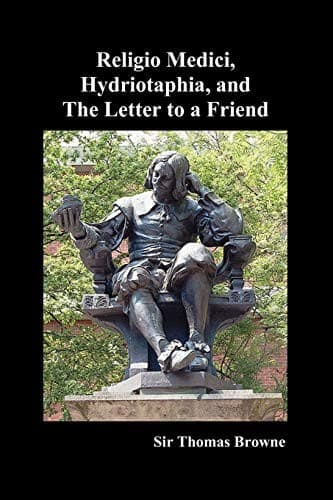
Religio Medici, Hydriotaphia, and the Letter to a FriendBrowne, Thomas, Sir
Religion
Religio Medici, Hydriotaphia, and the Letter to a Friend
Browne, Thomas, Sir
Christian ethics; Christian life; Essays; Funeral rites and ceremonies; Medical ethics; Medicine -- History; Religion and medicine
to-day, what our better advanced judgments will unteach to-morrow; and
Aristotle doth but instruct us, as Plato did him, that is, to confute
himself. I have run through all sorts, yet find no rest in any: though
our first studies and junior endeavours may style us Peripateticks,
Stoicks, or Academicks, yet I perceive the wisest heads prove, at
last, almost all Scepticks,[94] and stand like Janus in the field of
knowledge. I have therefore one common and authentick philosophy I
learned in the schools, whereby I discourse and satisfy the reason of
other men; another more reserved, and drawn from experience, whereby I
content mine own. Solomon, that complained of ignorance in the height
of knowledge, hath not only humbled my conceits, but discouraged my
endeavours. There is yet another conceit that hath sometimes made me
shut my books, which tells me it is a vanity to waste our days in the
blind pursuit of knowledge: it is but attending a little longer, and
we shall enjoy that, by instinct and infusion, which we endeavour at
here by labour and inquisition. It is better to sit down in a modest
ignorance, and rest contented with the natural blessing of our own
reasons, than by the uncertain knowledge of this life with sweat and
vexation, which death gives every fool gratis, and is an accessary of
our glorification.
_Sect._ 9.--I was never yet once, and commend their resolutions who
never marry twice. Not that I disallow of second marriage; as neither
in all cases of polygamy, which considering some times, and the unequal
number of both sexes, may be also necessary. The whole world was made
for man, but the twelfth part of man for woman. Man is the whole world,
and the breath of God; woman the rib and crooked piece of man. I could
be content that we might procreate like trees, without conjunction, or
that there were any way to perpetuate the world without this trivial
and vulgar way of coition: it is the foolishest act a wise man commits
in all his life, nor is there anything that will more deject his cooled
imagination, when he shall consider what an odd and unworthy piece
of folly he hath committed. I speak not in prejudice, nor am averse
from that sweet sex, but naturally amorous of all that is beautiful.
I can look a whole day with delight upon a handsome picture, though
it be but of an horse. It is my temper, and I like it the better,
to affect all harmony; and sure there is musick, even in the beauty
and the silent note which Cupid strikes, far sweeter than the sound
of an instrument. For there is a musick wherever there is a harmony,
order, or proportion; and thus far we may maintain “the musick of the
spheres:” for those well-ordered motions, and regular paces, though
they give no sound unto the ear, yet to the understanding they strike
a note most full of harmony. Whatsoever is harmonically composed
delights in harmony, which makes me much distrust the symmetry of those
heads which declaim against all church-musick. For myself, not only
Public-domain text, read in full here on John Shaqi.
Reviews
Reviews
No reviews yet
Be the first to share your thoughts on this work.
Elsewhere in the archive
Join the Discussion
Join the discussion
Sign in to leave a comment or review.
Sign InorCreate an account