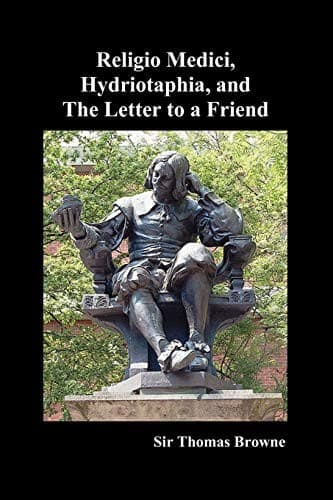
Religio Medici, Hydriotaphia, and the Letter to a FriendBrowne, Thomas, Sir
Religion
Religio Medici, Hydriotaphia, and the Letter to a Friend
Browne, Thomas, Sir
Christian ethics; Christian life; Essays; Funeral rites and ceremonies; Medical ethics; Medicine -- History; Religion and medicine
from my obedience but my particular genius I do embrace it: for even
that vulgar and tavern-musick which makes one man merry, another mad,
strikes in me a deep fit of devotion, and a profound contemplation of
the first composer. There is something in it of divinity more than
the ear discovers: it is an hieroglyphical and shadowed lesson of the
whole world, and creatures of God,--such a melody to the ear, as the
whole world, well understood, would afford the understanding. In brief,
it is a sensible fit of that harmony which intellectually sounds in
the ears of God. I will not say, with Plato, the soul is an harmony,
but harmonical, and hath its nearest sympathy unto musick: thus some,
whose temper of body agrees, and humours the constitution of their
souls, are born poets, though indeed all are naturally inclined unto
rhythm. This made Tacitus, in the very first line of his story, fall
upon a verse;[P] and Cicero, the worst of poets, but declaiming for a
poet, falls in the very first sentence upon a perfect hexameter.[Q] I
feel not in me those sordid and unchristian desires of my profession;
I do not secretly implore and wish for plagues, rejoice at famines,
revolve ephemerides and almanacks in expectation of malignant aspects,
fatal conjunctions, and eclipses. I rejoice not at unwholesome springs
nor unseasonable winters: my prayer goes with the husbandman’s; I
desire everything in its proper season, that neither men nor the times
be out of temper. Let me be sick myself, if sometimes the malady of
my patient be not a disease unto me. I desire rather to cure his
infirmities than my own necessities. Where I do him no good, methinks
it is scarce honest gain, though I confess ’tis but the worthy salary
of our well intended endeavours. I am not only ashamed but heartily
sorry, that, besides death, there are diseases incurable; yet not for
my own sake or that they be beyond my art, but for the general cause
and sake of humanity, whose common cause I apprehend as mine own.
And, to speak more generally, those three noble professions which all
civil commonwealths do honour, are raised upon the fall of Adam, and
are not any way exempt from their infirmities. There are not only
diseases incurable in physick, but cases indissolvable in law, vices
incorrigible in divinity. If general councils may err, I do not see
why particular courts should be infallible: their perfectest rules are
raised upon the erroneous reasons of man, and the laws of one do but
condemn the rules of another; as Aristotle ofttimes the opinions of
his predecessors, because, though agreeable to reason, yet were not
consonant to his own rules and the logick of his proper principles.
Again,--to speak nothing of the sin against the Holy Ghost, whose cure
not only, but whose nature is unknown,--I can cure the gout or stone
in some, sooner than divinity, pride, or avarice in others. I can cure
vices by physick when they remain incurable by divinity, and they shall
Public-domain text, read in full here on John Shaqi.
Reviews
Reviews
No reviews yet
Be the first to share your thoughts on this work.
Elsewhere in the archive
Join the Discussion
Join the discussion
Sign in to leave a comment or review.
Sign InorCreate an account