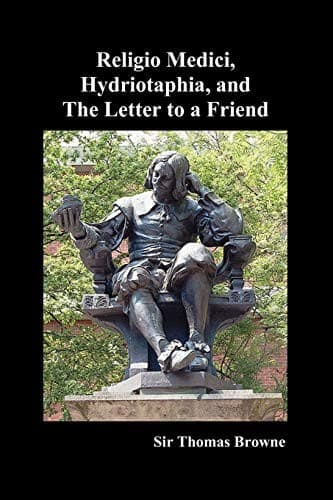
Religio Medici, Hydriotaphia, and the Letter to a FriendBrowne, Thomas, Sir
Religion
Religio Medici, Hydriotaphia, and the Letter to a Friend
Browne, Thomas, Sir
Christian ethics; Christian life; Essays; Funeral rites and ceremonies; Medical ethics; Medicine -- History; Religion and medicine
obey my pills when they contemn their precepts. I boast nothing, but
plainly say, we all labour against our own cure; for death is the cure
of all diseases. There is no _catholicon_ or universal remedy I know,
but this, which though nauseous to queasy stomachs, yet to prepared
appetites is nectar, and a pleasant potion of immortality.
[P] “Urbem Romam in principio reges habuere.”
[Q] “In qua me non inficior mediocriter esse.”--_Pro Archia Poeta_.
_Sect._ 10.--For my conversation, it is, like the sun’s, with all men,
and with a friendly aspect to good and bad. Methinks there is no man
bad; and the worst best, that is, while they are kept within the circle
of those qualities wherein they are good. There is no man’s mind of
so discordant and jarring a temper, to which a tuneable disposition
may not strike a harmony. _Magnæ virtutes, nec minora vitia;_ it is
the posy[95] of the best natures, and may be inverted on the worst.
There are, in the most depraved and venomous dispositions, certain
pieces that remain untouched, which by an _antiperistasis_[96] become
more excellent, or by the excellency of their antipathies are able
to preserve themselves from the contagion of their enemy vices, and
persist entire beyond the general corruption. For it is also thus in
nature: the greatest balsams do lie enveloped in the bodies of the most
powerful corrosives. I say moreover, and I ground upon experience,
that poisons contain within themselves their own antidote, and that
which preserves them from the venom of themselves; without which they
were not deleterious to others only, but to themselves also. But it is
the corruption that I fear within me; not the contagion of commerce
without me. ’Tis that unruly regiment within me, that will destroy me;
’tis that I do infect myself; the man without a navel[97] yet lives in
me. I feel that original canker corrode and devour me: and therefore,
“_Defenda me, Dios, de me!_” “Lord, deliver me from myself!” is a
part of my litany, and the first voice of my retired imaginations.
There is no man alone, because every man is a microcosm, and carries
the whole world about him. “_Nunquam minus solus quam cum solus,_”[R]
though it be the apothegm of a wise man is yet true in the mouth of a
fool: for indeed, though in a wilderness, a man is never alone; not
only because he is with himself, and his own thoughts, but because he
is with the devil, who ever consorts with our solitude, and is that
unruly rebel that musters up those disordered motions which accompany
our sequestered imaginations. And to speak more narrowly, there is no
such thing as solitude, nor anything that can be said to be alone, and
by itself, but God;--who is his own circle, and can subsist by himself;
all others, besides their dissimilary and heterogeneous parts, which in
a manner multiply their natures, cannot subsist without the concourse
of God, and the society of that hand which doth uphold their natures.
Public-domain text, read in full here on John Shaqi.
Reviews
Reviews
No reviews yet
Be the first to share your thoughts on this work.
Elsewhere in the archive
Join the Discussion
Join the discussion
Sign in to leave a comment or review.
Sign InorCreate an account