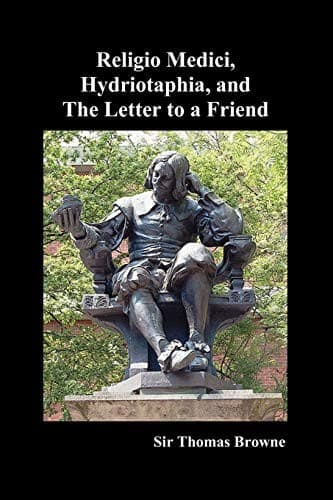
Religio Medici, Hydriotaphia, and the Letter to a FriendBrowne, Thomas, Sir
Religion
Religio Medici, Hydriotaphia, and the Letter to a Friend
Browne, Thomas, Sir
Christian ethics; Christian life; Essays; Funeral rites and ceremonies; Medical ethics; Medicine -- History; Religion and medicine
When the bones of King Arthur were digged up,[AA] the old race might
think they beheld therein some originals of themselves; unto these
of our urns none here can pretend relation, and can only behold the
relicks of those persons who, in their life giving the laws unto their
predecessors, after long obscurity, now lie at their mercies. But,
remembering the early civility they brought upon these countries, and
forgetting long-passed mischiefs, we mercifully preserve their bones,
and piss not upon their ashes.
[AA] In the time of Henry the Second.
In the offer of these antiquities we drive not at ancient families,
so long outlasted by them. We are far from erecting your worth upon
the pillars of your forefathers, whose merits you illustrate. We
honour your old virtues, conformable unto times before you, which are
the noblest armoury. And, having long experience of your friendly
conversation, void of empty formality, full of freedom, constant and
generous honesty, I look upon you as a gem of the old rock,[AB] and
must profess myself even to urn and ashes.--Your ever faithful Friend
and Servant,
[AB] “Adamas de rupe veteri præstantissimus.”
THOMAS BROWNE.
NORWICH, _May 1st_.
HYDRIOTAPHIA.
CHAPTER I.
IN the deep discovery of the subterranean world a shallow part would
satisfy some inquirers; who, if two or three yards were open about the
surface, would not care to rake the bowels of Potosi,[AC] and regions
toward the centre. Nature hath furnished one part of the earth, and man
another. The treasures of time lie high, in urns, coins, and monuments,
scarce below the roots of some vegetables. Time hath endless rarities,
and shows of all varieties; which reveals old things in heaven, makes
new discoveries in earth, and even earth itself a discovery. That great
antiquity America lay buried for thousands of years, and a large part
of the earth is still in the urn unto us.
[AC] The rich mountain of Peru.
Though if Adam were made out of an extract of the earth, all parts
might challenge a restitution, yet few have returned their bones far
lower than they might receive them; not affecting the graves of giants,
under hilly and heavy coverings, but content with less than their
own depth, have wished their bones might lie soft, and the earth be
light upon them. Even such as hope to rise again, would not be content
with central interment, or so desperately to place their relicks as
to lie beyond discovery; and in no way to be seen again; which happy
contrivance hath made communication with our forefathers, and left unto
our view some parts, which they never beheld themselves.
Though earth hath engrossed the name, yet water hath proved the
smartest grave; which in forty days swallowed almost mankind, and the
living creation; fishes not wholly escaping, except the salt ocean were
handsomely contempered by a mixture of the fresh element.
Public-domain text, read in full here on John Shaqi.
Reviews
Reviews
No reviews yet
Be the first to share your thoughts on this work.
Elsewhere in the archive
Join the Discussion
Join the discussion
Sign in to leave a comment or review.
Sign InorCreate an account