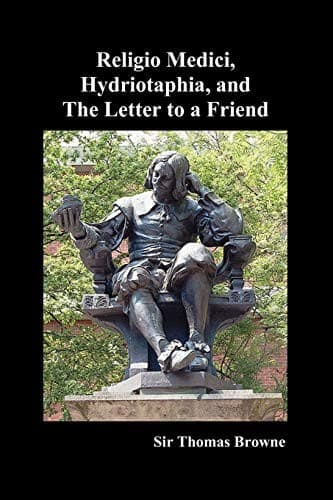
Religio Medici, Hydriotaphia, and the Letter to a FriendBrowne, Thomas, Sir
Religion
Religio Medici, Hydriotaphia, and the Letter to a Friend
Browne, Thomas, Sir
Christian ethics; Christian life; Essays; Funeral rites and ceremonies; Medical ethics; Medicine -- History; Religion and medicine
Many have taken voluminous pains to determine the state of the soul
upon disunion; but men have been most phantastical in the singular
contrivances of their corporal dissolution: whilst the soberest nations
have rested in two ways, of simple inhumation and burning.
That carnal interment or burying was of the elder date, the old
examples of Abraham and the patriarchs are sufficient to illustrate;
and were without competition, if it could be made out that Adam was
buried near Damascus, or Mount Calvary, according to some tradition.
God himself, that buried but one, was pleased to make choice of this
way, collectible from Scripture expression, and the hot contest between
Satan and the archangel about discovering the body of Moses. But the
practice of burning was also of great antiquity, and of no slender
extent. For (not to derive the same from Hercules) noble descriptions
there are hereof in the Grecian funerals of Homer, in the formal
obsequies of Patroclus and Achilles; and somewhat elder in the Theban
war, and solemn combustion of Meneceus, and Archemorus, contemporary
unto Jair the eighth judge of Israel. Confirmable also among the
Trojans, from the funeral pyre of Hector, burnt before the gates of
Troy: and the burning of Penthesilea the Amazonian queen: and long
continuance of that practice, in the inward countries of Asia; while as
low as the reign of Julian, we find that the king of Chionia[AD] burnt
the body of his son, and interred the ashes in a silver urn.
[AD] Gumbrates, king of Chionia, a country near Persia.
The same practice extended also far west; and besides Herulians, Getes,
and Thracians, was in use with most of the Celtæ, Sarmatians, Germans,
Gauls, Danes, Swedes, Norwegians; not to omit some use thereof among
Carthaginians and Americans. Of greater antiquity among the Romans
than most opinion, or Pliny seems to allow: for (besides the old table
laws[AE] of burning or burying within the city, of making the funeral
fire with planed wood, or quenching the fire with wine), Manlius the
consul burnt the body of his son: Numa, by special clause of his will,
was not burnt but buried; and Remus was solemnly burned, according to
the description of Ovid.[AF]
[AE] XII. Tabulæ, part i., de jure sacro, “Hominem mortuum in urbe ne
sepelito neve urito.”
[AF] “Ultima prolata subdita flamma rogo,” &c. _Fast._, lib. iv., 856.
Public-domain text, read in full here on John Shaqi.
Reviews
Reviews
No reviews yet
Be the first to share your thoughts on this work.
Elsewhere in the archive
Join the Discussion
Join the discussion
Sign in to leave a comment or review.
Sign InorCreate an account